Marinos Skolarikos Editor 12/12/2024
About a month after receiving the prestigious ASI Best Sommelier title for Europe, Africa, and the Middle East, we discuss with Mikk Parre about his journey, the ASI competition, and his philosophy on mastering the art of wine.
Mikk Parre...
I have been working in the hospitality industry for about 13 years, having spent my entire working career so far in Tallinn, Estonia. I started my journey as a waiter, climbed up to be a restaurant manager and then found my real passion in the world of wine. I have been a sommelier in both casual and high end Michelin star restaurants and just 5 months ago left my position as the head sommelier of one of the best wine bars of the Baltics to try out a slightly different role. Currently I am working for Bombay Group in Tallinn but in a behind the scenes role, not running a wine program anymore.
I have been taking part in various sommelier competitions for about 5 years now, having previously won the titles of best sommelier of Estonia in 2022 and 2023 as well as the best sommelier of the Baltics in 2022 and 2024. In 2022 I also obtained the ASI Gold Diploma.

Mikk Parre
How do you feel about being declared the best sommelier in Europe, Africa ME, at the recent ASI competition held in Belgrade on 17 November 2024?
I am actually feeling surprisingly normal after all of this, which is quite strange. I think everything still hasn't hit yet.
But I have received a ton of good wishes from people around the world and very positive feedback from supporters and fellow sommeliers alike. Seeing how friendly, positive and supporting everyone in this industry is makes this all a very humbling experience. I am very grateful to the people who supported me in this journey, and I hope this title can bring more attention and activity to both Estonia and the Baltic region in general. I can only hope to be the role model others have been before me.
How did you prepare for the competition? One sommelier explained how he approaches this competition like a professional athlete. Do you agree with this view?
Preparation for me hasn't been just for this one competition but rather a longer journey that started with the first ASI Bootcamp back in 2021. My one goal and focus were to see and be part of the World Championships, which I managed in 2023, with a very intense 2 year preparation before that, consisting of many smaller competitions and a strong focus on theory, at some periods 4-6 hours every day. What I learned from my shortcomings there was that you need a good balance between studying, work and family, so I actually toned down the intensity quite a bit and tried to be in a better mental state most of all, which apparently worked well.
I completely agree that preparing for a competition is very much like the preparation of an athlete. You need to stay focused and motivated and have a proper studying schedule and a routine for things to go according to plan. You must also find the time to relax and not overdo it, as timing your form is just as important as for athletes. You see many athletes struggling also with the mental side and the pressure, which is also the case for competing sommeliers. Once you have a good foundation, I believe it is much more important to be in a good mood and mental state than to go out of your way to memorize a few more villages or vintages.

Mikk Parre
During your preparation for the competition, what is the most surprising and interesting thing you learned?
The world of wine and the extended beverage world in addition is so full of wonders that every time you open a new book or read a new article you discover something new. This is the main reason that keeps many of us attached to the life of a sommelier, the never-ending thirst for knowledge.
This time around I focused on some subjects I was quite unfamiliar with before, so the biggest fascination I discovered for myself were actually the worlds of Sake and Cigars. In Estonia both of those worlds are very much in their baby steps so just to learn to complex and multifaceted these worlds was a thrill on its own. The sheer effort that goes into the process of making cigars really makes me take the hat off for the farmers and the complexity and style variation of Sake left me thirsty for more!
We would like to hear about the 7 challenges you had during the competition according to the ASI Sommelier Guidelines.
The process was a bit longer than just the 7 challenges spectators saw in the finals, with tastings, a quick practical task and a difficult theory paper in the quarter finals and 6 other practical tasks in the semi-finals. But of course, the final is what most people see and the part that is also the most interesting often.
The finals started with a very simple task of serving 3 different drinks to a table of 3 guests. Seemingly a very easy task but designed to divert your attention with multiple questions from the guests during service. The key in a task like this is to be quick and precise, by identifying the correct beverages quickly and making sure they are also in good condition. You gain points for choosing the correct beverage, correct glassware for each beverage and of course for following the correct order and service standards while gaining bonus points for food recommendations and answering the guest’s questions correctly.
It was followed by a blind tasting of 4 spirits, which all happened to be Cognacs from different sub-regions of Cognac, served at barrel strength for extra difficulty. There isn't much else to a task like that than just your ability to recognize the beverages as closely as possible. In hindsight, it might have been more beneficial to just focus on the aroma of the spirits or use water for dilution as barrel strength spirits really mess with your palate. As an additional task here you had to assign them to the correct sub-region of Cognac after the initial task.
Following that there was another classic service task, of serving a bottle of Moldovan red wine to a table of six. The judges expected the wine to be decanted as there was possible sediment in the wine, but seeing as there were extra elements in place for an additional task I decided to do an aeration instead to save time and thus I also managed to complete the task on time and complete the extra task of serving a glass of cloudy sake to one guest as well. Often in situations like that you must make the snap decision of whether you do the task precisely and risk not finishing or take some shortcuts to make sure you end in time. It is after all a game of points, completing a task in this case probably earns more points than lighting a candle and decanting the wine instead of just aerating it.

Mikk Parre - Oliver Poussier
A full organoleptic blind tasting of 2 reds followed, again a very classical task where you gain points for both following the structure of the tasting as well as calling the correct things. Most points are usually gained by calling the grape, country, region and vintage as they are always the most difficult ones to get correct. The additional trick here was that there were 2 different wines by the same producer, so you also had to get that they were wines from the same grape, same region and made by the same producer.
Another blind tasting followed, where we had to identify several wines, which turned out to be all made from the same grape - Muscat. It was incredibly difficult to get that common point, but the more correct calls you made the more points you gained, easy as that. Points are awarded for all correct calls, including just vintage or country, you don't have to correctly identify all aspects of a wine to get points.
Second to last was the task of correcting a wine list. Something that requires deep knowledge of wines, producers and styles and also attention to detail. Mistakes can lie anywhere from the wrong producer, vintage that wasn't made to a simple spelling mistake. Pointing out correct mistakes as well as wines which are correct in the first place is the goal.
Final task was a picture round performed all together on a stage. Always a little bit more relaxing and fun round, but one that requires a very broad spectrum of knowledge from all aspects of the sommelier world. Identifying tools, wineries, famous people and labels is tricky especially when under pressure.
All in all it was a very classic but thorough final, that tested most aspects of what a sommelier should know and be able to do, without being too difficult, so it was built around whoever managed to be the fastest and have the best attention to detail.

Mikk Parre
What are the qualifications required to become a great sommelier and what advice would you give to a younger person wishing to follow in your footsteps.
I think to be a great sommelier you need first of all an endless thirst for knowledge, which is the key driving factor I believe for all previous winners as well. Without that deep-rooted desire to know more and more about this fascinating world it is an almost impossible task to get far in this world.
The second key aspect I believe is humanity and the ability to stay humble. After all a sommelier is someone whose job is to help others and to guide their way in the impossibly complicated maze of wines. You have to be able to relate yourself to others and see the world how they think it is. Sommelier in my opinion is not the one who has to say what is right or wrong but help others reach that conclusion on their own, which requires a certain skill of its own.
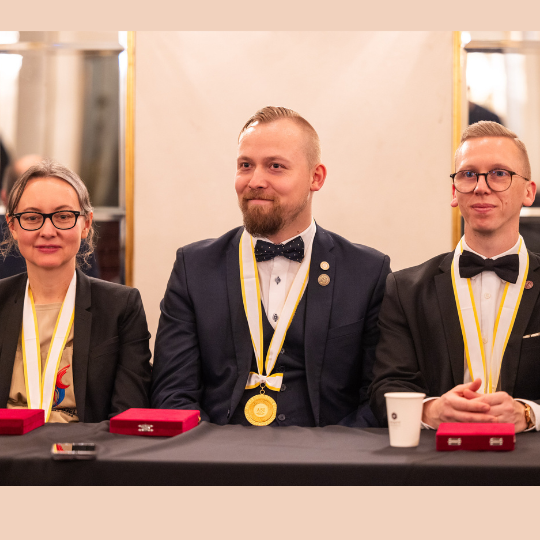
Pascaline Lepeltier, Mikk Parre, Martynas Pravilonis
The best advice I can give to others is to follow the passion, no matter where it lies. Not everyone has to be or wants to be a competing sommelier, but that same drive and passion should guide everyone who wants to go far in this world. Secondly, never stop exploring and don't be afraid of the unknown. Taste wines from every new region, grape or country you can, this world is wonderfully diverse, and greatness can be found in the most unexpected places.
Photo Credit: ASI 2024