I first heard the name Georgios Venetsanos in 1988 when the Union of Greek Chemists awarded him an honorary diploma for his long-standing and fruitful contribution to the development of Oenology and the Wine Industry in Greece.
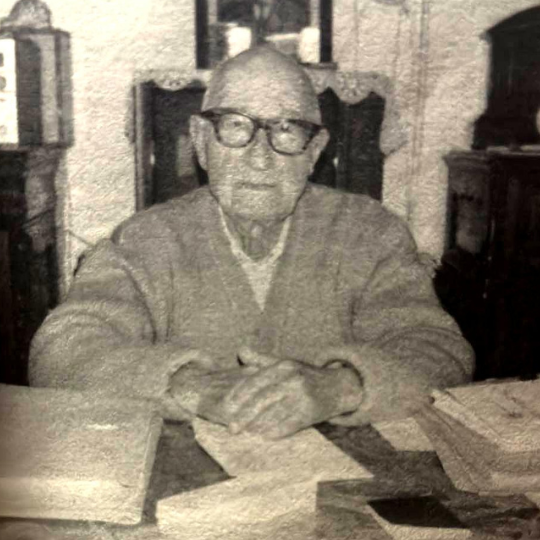
Georgios Venetsanos at his home office in Megalochori, Santorini, early 1990s
That was when I learned that the honoree was the second son of Antonios Venetsanos, who had returned with his family from Egypt in the 1920s, settled in Megalochori, Santorini, and traded large quantities of wine. The scientific oversight of this valuable commodity was ensured by the younger son, Georgios, who studied chemistry at the Faculty of Physics and Mathematics at the University of Athens from 1933 to 1938.
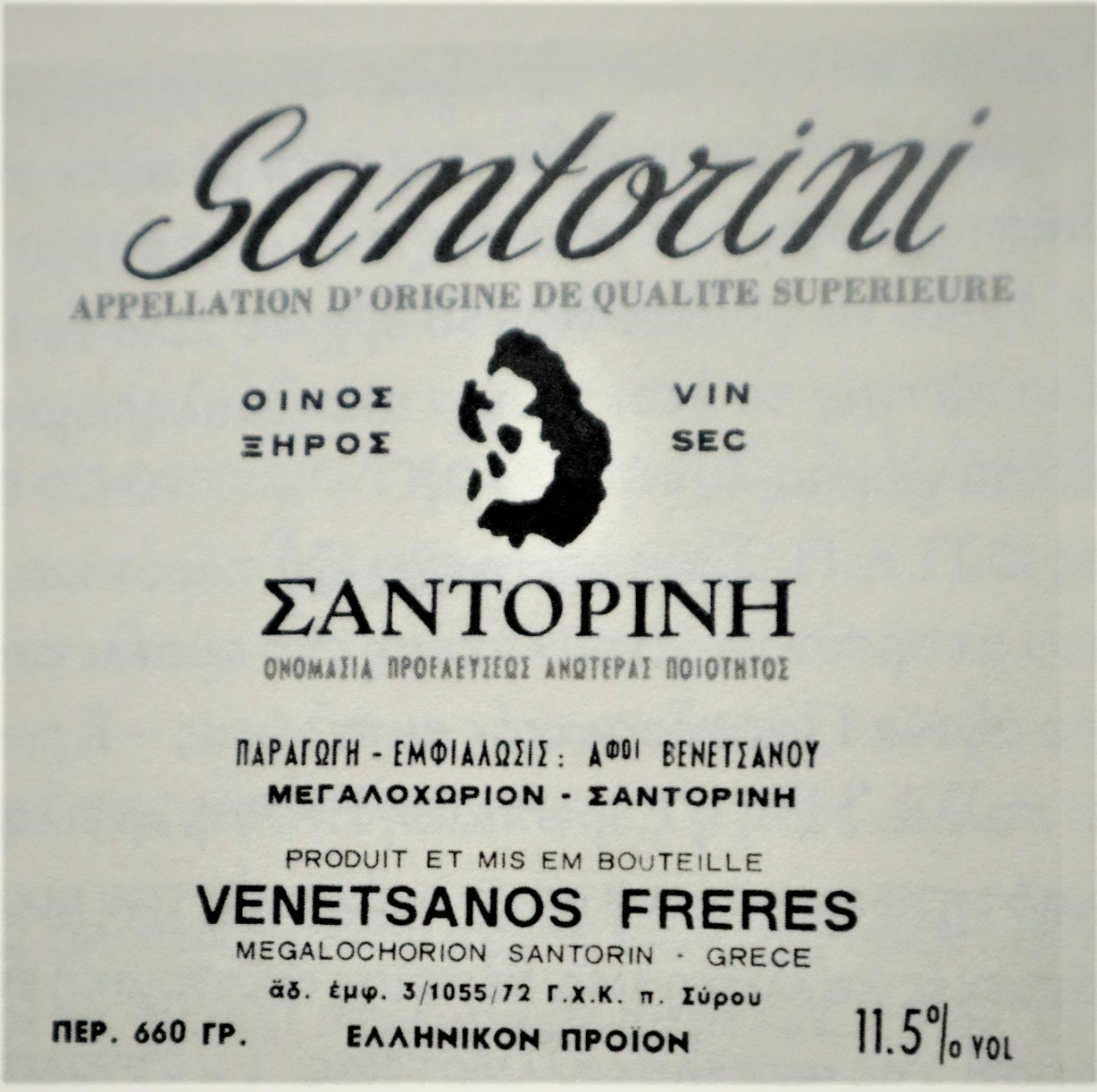
In the late 1940s, the privately owned Venetsanos Brothers Winery began operations in Megalochori, marking the end of pre-industrial winemaking in the island’s kanaves (traditional wine cellars). The visionary and architect of this original and pioneering project was chemist-oenologist Georgios Venetsanos, while his brother Zannos became a skilled wine merchant, as he himself describes in his book.
Five years after his award, in 1993, I had the opportunity to visit Georgios Venetsanos in Santorini for the first time. He welcomed me into his home office in Megalochori, where we had a long and engaging conversation. During this discussion, he opened up his invaluable archives, and I fully realized the importance of the honorary diploma he had received.
I describe these archives as "invaluable" because the tireless chemist-oenologist, viticulturist, and winemaker had compiled decades’ worth of data on the annual grape production of Santorini’s vineyards and the physicochemical factors that influenced it. He had also meticulously documented how various types of wine were traditionally made in pre-industrial Santorini, wines that are still produced today, but now in accordance with modern technology. His work preserved significant insights into pre-industrial winemaking, something that no other region in Greece has studied so systematically.
I was particularly impressed by the tables he had compiled, detailing the basic chemical composition of sweet wines produced by Santorini’s winemakers using traditional methods, without scientific supervision. These were wines made purely from the experience of each winemaker, accurately reflecting ancient and historical practices when there were no scientific tools to measure elements such as must density or the alcohol content produced during fermentation.
As I examined these tables and listened to him describe how the sun-dried sweet wine of Santorini, the famous Vinsanto, is still made today, I felt as if the verses 609-615 of Hesiod’s "Works and Days" came to life. In these lines, Hesiod describes how grapes were sun-dried to produce Biblinos wine, which he himself drank while herding his brother’s sheep in Askri, Viotia.
These historical records shed light on how ancient and medieval sweet wines were made. That is why, in an article about the honey-sweet wines of Homer, I referred to Georgios Venetsanos’ tables as an oenological treasure.
Beyond oenology, he had a deep passion for folklore. A special folder in his archives was dedicated to traditional winemaking terms used in Santorini, as well as the repairs and maintenance of wine tools and equipment.
On that day, he gave me a collection of folklore writings, in which he recorded old proverbs, songs, and expressions, gathered over many years from Santorini’s schools and monasteries.
Before publishing his work, he told me,
"We have over 4,000 traditions in Thira. Let’s not lose them to tourism development."
That meeting was not our last. I urged him not to leave his vast knowledge unpublished, promising to support him by reviewing his writings and offering feedback. This led to a rich correspondence and a deep friendship that lasted about twelve years, until his passing in 2004.
One day, he sent me a text about loading wineskins onto pack animals, but I couldn't understand the process. I drew three different methods and wrote to him,
"This is what I understand, but I fear I may be mistaken."
On April 2, 1996, he replied, sending me a small sketch, saying:
"I am not a great artist, but I believe this will help you understand."

The Sketch
By then, his book was complete, and one of his nephews, Samson Katsinis, had typed the manuscript on a computer. In 2002, when he visited Athens, he handed it to me, saying:
"Keep it until I find a sponsor to publish it."
I was overwhelmed by the responsibility of holding such a treasured intellectual work, uncertain for how many years.
I was right to be concerned. When he passed away in April 2004, I promised him in my farewell speech:
"Your unpublished work will be printed and shared. When the harvest comes, we will place a basket filled with Assyrtiko and Mandilaria grapes at your grave as an offering, and your soul will rejoice… Because here, on your island, you will always be harvesting. Where else?"
Eleven years passed, and I did not know the whereabouts of his manuscript. However, his nephews and heirs, Anastasios-Nikolaos and Evangelos Zorzos, renovated and reopened the Venetsanos Winery in 2015.
Rest in peace, my friend.
You lived a life full of wisdom and knowledge, offering a legacy of creativity that will continue to speak of a lost era.
You made friends who cherished and admired you.
May the Thiran soil, the aspa, that covers you, be light and gentle.
Written by the Grand Lady of Greek Wine, Stavroula Kourakou-Dragona
Excerpt from the book: "Traditional Winemaking in Santorini" (March 2016)
Text edited by: Marinos Skolarikos
? Photo Credit: Venetsanos Winery