Marinos Skolarikos, editor 23 March 2025.
Today we're thrilled to host an insightful conversation today with esteemed sommelier Maxime Dubois.
Can you introduce yourself and share a bit about your background ? How did you become a sommelier ?
My name is Maxime and I am originally from Normandy, in the Northwest of France. Although we once were home to a substantial vineyard, the past centuries have proven better for the culture of apples for cider or calvados. Therefore, I did not grow up surrounded by vines at all and discovered my love for it quite late in my life.
I stumbled upon wine as part of my career in hospitality. As the great French gastronomist Brillat-Savarin once said : «to host someone is to look after their happiness for the time they are under your roof». This noble mission that every restaurant staff is carrying every day, is largely made of the joy found in matching a great wine, delicious food and lovely conversations.
As part of my studies in Restaurant Management in Paris, I received some training on wine which, at the time, was almost exclusively dedicated to French wine. To my surprise, as I started my career running a restaurant in Dublin, Ireland, I discovered the large diversity of other International terroirs. My lack of knowledge and understanding for these wines coming from faraway valleys and hillslopes is what pushed me to undertake sommelier studies with ASI first, through the Irish Guild of Sommeliers, and the Court of Master Sommeliers Europe then. I was bitten by the wine bug back in 2014, which led me to the project « Food Vinebrations », 15 months of travels across 15 countries to discover producers of wines and local delicacies. And everywhere you go, where there is wine, there is an inherent passion for nature and the little pleasures of life !
Wine can be approached from so many angles : geography, geology, history, science, taste, etc… I still haven’t grown tired of it. But the more I have been learning about other terroirs of the World, the more I realized that many of them were claiming inspiration in some French regions or techniques. Being a huge fan of fresh wines from cooler-climate areas over the more structures and « sun-filled » ones, I was naturally drawn to the study of Bourgogne, craddle of the concept of « terroir ».
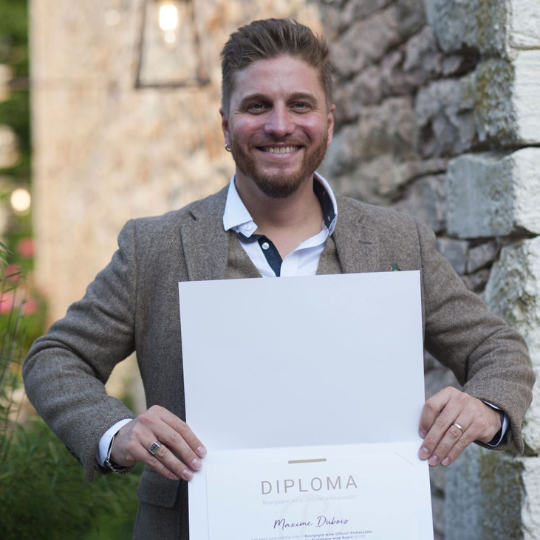
Maxime Dubois - Diploma award
What does a typical day look like in your role ?
Today, my role is split between my passion for teaching wine in Vietnam and my role of area director Asia Pacific for a major French wine producer. I have developed specific programs dedicated to the translation, not only of the language of wine, but more importantly of its cultural aspect.
In my opinion, too many programs just take Western concepts and translate the language without caring for the local cultures which may not understand the very essence of what is taught. The concept of pairing food and wine is not global, for it is just a drink in many parts of the world. Describing flavours of cherry, gooseberry and violet doesn’t mean much to people in Southeast Asia. However, understanding that the molecules that make the smell of a strawberry are incredibly close to those of a pineapple, and accepting therefore that when I smell strawberry and my students say « pineapple » we are on the same page, that’s important !
On my first class taught in Vietnam, years ago, we were blind tasting a Marlborough Sauvignon Blanc. One of my students said « durian » on the nose, which is a very fragrant, rather decadent tropical fruit found in Southeast Asia, prohibited in most public places for its strong smell. At the time, I did not really know the smell of durian, so I had to go and check it out. Now, there is not a single glass of Sauvignon Blanc in which I don’t smell durian or its cousin jackfruit.
My teaching days are spent collecting information on the ground, things that my students can easily relate with, and trying to translate some French wine concepts using these tools. Teaching wine is also a great way for me to stay up-to-date in my knowledge and it helps me immensely in my sales position, to better understand the needs of importers and clients.
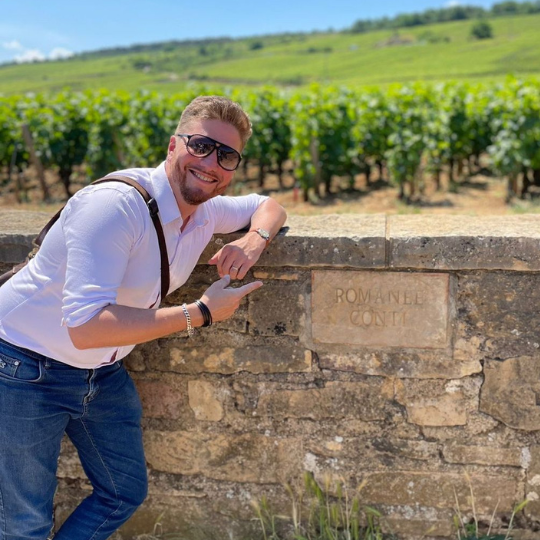
Maxime Dobois in Romanee Conti
How important is storytelling when recommending wines to guests ?
Huge ! Wine is the product of a magical interaction between the land and the people, all trapped together by grapes. Our role is major in transmitting this background to people who want to crack a bottle and enjoy it best. Of course, you can take pleasure without knowing anything about the bottle you’re drinking, just because it’s good (which is super important too !). But the pleasure found in the understanding of what happened through days, months, sometimes years, to make this bottle happen, this is something else.
Understanding that this saline, iodine-like smell of seabreeze in your glass of Chablis is probably reminiscent of an Ocean that disappeared 200 million years ago, or that the fundamental difference between the power of a Gevrey-Chambertin and the seductive aromas of a Chambolle-Musigny happened 50 million years ago when the Alps rose from the ground and shifted the earth around ! Getting your head around the natural freshness brought by altitude in a glass of Saint-Romain, or the incredible difference between some terroirs of Corton, mostly due to the direction the vines are facing.
And of course, beyond all of these natural conditions, there are all the stories of the families who dedicate their lives in a quest for making the best wine. We hear a lot of things about « natural wines » and a concept of « non-intervention » today, which I find confusing for consumers as the natural product of crushed grapes is vinegar. If it is wine, if there there is alcohol instead of acetic acid, then it is man-made and we should not forget the people who had to make so many decisions along the way. When to harvest ? Stems or no stems ? Which plots to blend ? What kind of ageing ? In what vessels ? All of these stories can help the consumers understand it better and take more pleasure in every sip.
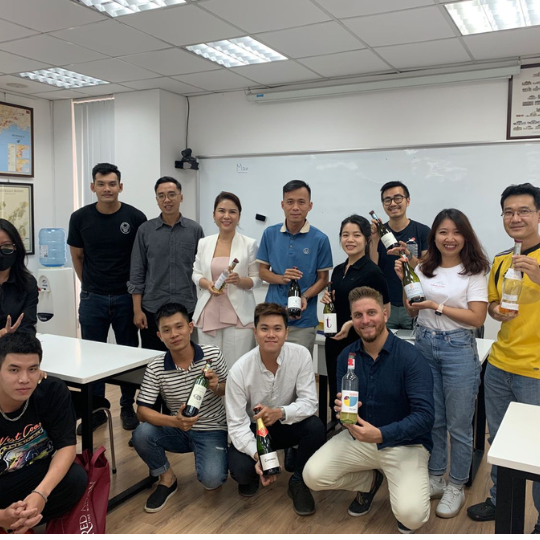
WSET 1 Saigon
What’s your personal philosophy when it comes to wine and hospitality ?
I do not believe in the exactitude of wine pairings. Somehow, it adds a considerable amont of fear to something as simple as picking a bottle on a list. In my opinion, a perfect pairing is made of good wine, good authentic food and great people. As I usually say to my students, if anyone tells you otherwise or criticizes a pairing you’ve chosen, don’t change the wine, change your friend.
Wine is about finding pleasure, whether it is the immediate one of a good taste or the more thoughtful one of understanding where that taste could come from. And pleasure is only good when it is shared. Bad company can really destroy a pairing, even if the meal and the wine were supposed to match perfectly.
Living in Asia also made me realize that the traditional boundaries of food and wine pairings as developed in France, don’t apply everywhere. The classic rythm of a French meal is like clockwork (starter, fish, meat, cheese, dessert) and each dish calls for a specific kind of wine. In Vietnam, all dishes arrive at the same time and are shared by all guests, most of them combine surf n’turf (shrimp and pork, chicken and fish sauce, etc…), which calls for a whole new style of pairings. In that matter, wines from cooler climates and less structured grape varieties such as Pinot Noir usually make great choices.
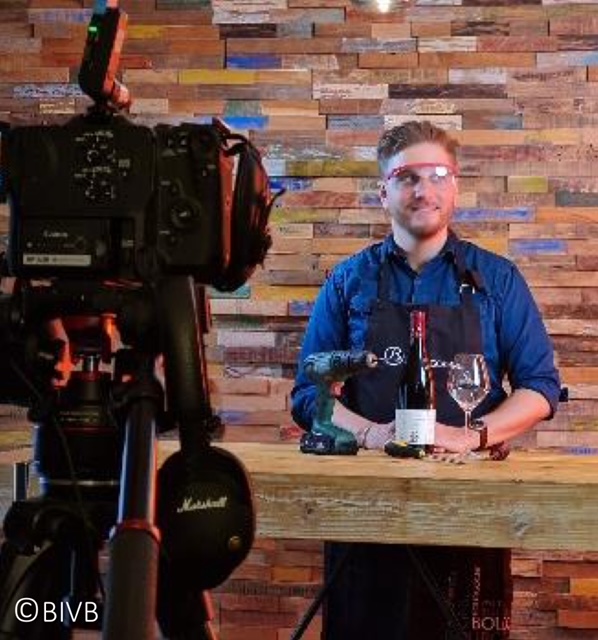
The Vins de Bourgogne Bureau series
Let’s talk about Vins de Bourgogne and your latest Instagram series about the famous appellation ?
It was an incredible experience and I felt so lucky to be a part of it ! The Vins de Bourgogne bureau (BIVB) was looking for a more casual, more modern way of communicating the passion for their wines, which was completely in phase with what I do.
As much as I love the study of wine, I also realize that very few people get excited over clay and limestone soils, or geological eras. Therefore, if the only access to wine is through such high-level, academic sources, people will just stop drinking it. I think it’s vital to put pleasure back at the centre of wine consumption. People don’t drink wine to get drunk, there are plenty of other drinks that can do that better. People drink wine for an experience, and putting words on some of the feelings we can perceive makes it even better. That’s what I have been trying to do with The Tasting Tips, and I genuinely hope it can help some wine lovers out there !
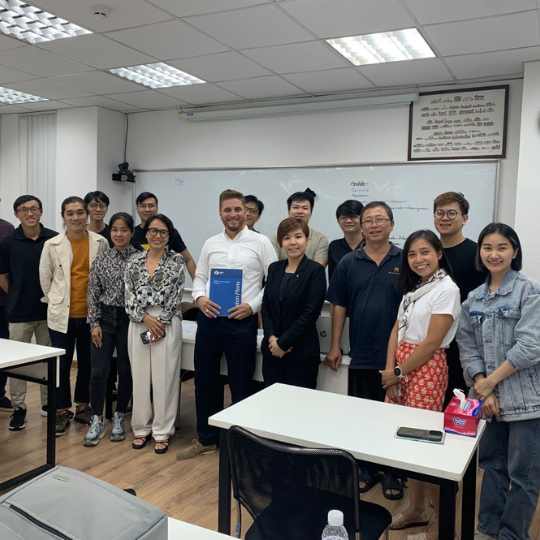
WSET 2 HCMC
As a Vins de Bourgogne wine ambassador in Vietnam, please describe the Asian market to us. What different sales strategies are applied compared to the European market.
Well, the good news is that there is a lot of interest in wine. A lot of people, mostly younger people, are joining the wine schools of the region to learn about this exotic drink and how to taste it. As a wine educator, I am blown away by the palate of most of my students in Vietnam. You might know that already but Vietnam is a foodies paradise, with smoking pots of soup and barbecues on every corner. People love to eat, and they enjoy this multitude of flavours from a very young age (no such thing as a kid’s meal here). Therefore, most people have a very good palate.
Also, the fact that Vietnamese cuisine doesn’t rely on the same pillars as most western cuisines (usually salt, fat and acid), means that people have less mental boundaries when they taste and smell. Students can smell chocolate and blood, vanilla and black olives, they do not prevent themselves from identifying sweet notes because the first nose was more savoury.
In terms of sales strategies and communication, wine is mostly considered a drink here, without the strong connection to food pairings that we are used to in Europe. As in most Asian markets, red wine dominates, but sparkling is on the rise, led by Champagne sales. There are three different regional wine markets in Vietnam. To put things simply : Hanoi in the North is a rather gift-driven market, people buy wine to offer to someone for special occasions. Red wine is seen as a more serious gift, mostly mid-range to premium from classic appellations and for that matter, Bourgogne is on the rise. In the South around Saigon, the market is more festive and people tend to buy wines for partying. Bubbles are doing particularly well across brunches and rooftop bars, but red wine remains dominant. Budget per bottle may be slightly lower, but it is made up in volumes. In the centre around the coastal city of Da Nang, the market is mostly seasonal and centered around resorts and hotels for international tourists, cheaper wines and some mid-range options dominate, of all colours.
Of course Asia is very large and every country has a different approach to wine. People do not drink the same things in the same way in Thailand, Hong Kong, Singapore and South Korea. But I think overall there is a growing interest in wine outside of mainland China, and a lot of markets that were looking for big famous labels until recently are shifting to a more mature quest for quality VS price ratio. People are a lot more educated about wine and make more reasonable choices nowadays.
Photo Credit: MAXIME DUBOIS, BIVB