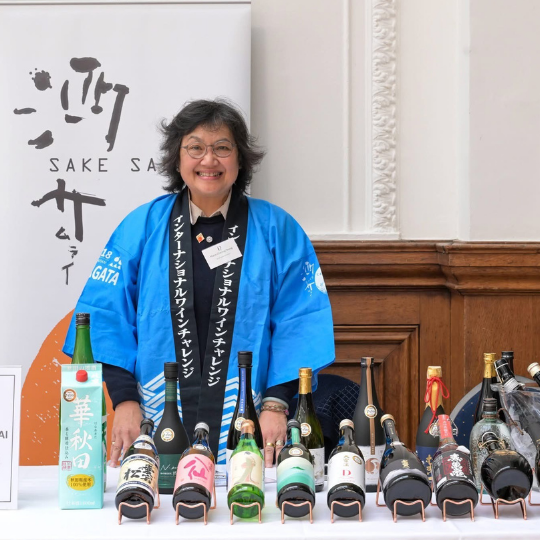
Allwinestories proudly hosts Marie Cheong Thong, Chairman British Sake Association, Chair Baijiu Association, Commitee Guild of Food Writers, Sake Samurai, WSET Certified Educator, Rectifier, The Gin Guild, Mousquetaire d' Armagnaq and Spirit Judging Comittee IWSC.
You’ve spent more than 18 years judging at leading international wine and spirits competitions, including chairing panels for sake, baijiu, and other Asian spirits. How has your perspective as a judge evolved over the years, and where do you believe global judging frameworks still fall short when it comes to Asian beverages?
An opportunity being in the right place at the right time.
Judging came to me by accident, back in 2005. I was tasked to check samples for a Master of Wine (who shall remain a nameless Saint) for his masterclass when he suddenly quipped, ”Marie why are you not judging in any competitions?”. I was invited to judge at the prestigious International Wine Challenge (IWC) in London. Today, I panel chair for the sake chapter (between London and Japan) and am a senior judge in the wine section. Its been an incredible journey working and learning from rather important people like OZ Clarke, Tim Atkins MW, Dr Jamie Goode, Peter McCombie MW, Anne Krebiehl MW, Kathy van Zyl MW, wine makers Brendan Heath and Ulrich Hoffmann - just to name but a few in London. Absolutely indebted to this MW without whom I would not be judging competitions worldwide, including the Berliner Wine Trophy, Mondial Strasbourg, Mundus Vini and a couple of competitions in the USA tasting fabulous wines over the years, meeting fellow professionals who have now become good friends and the OIV and Vinofed officials. The wine world is a friendly community and its been an honour.
From wines my journey dipped into Sake, Shochu, Baijiu and the plethora of both known spirits and indigeous spirits found in this wonderful world of ours.
Evolution, not quite Dinosaur to AI but still a word that is synonymous, I guess, to all life and definitely in my judging capacity.
I started ground up.
As the baby in the crib - “Be Humble” - my sole mantra. Learning from the greats and absorbing where, what and how to be a good judge was the most important criteria, knowing that senior judges who deem you useless meant the game was over.
The next stage - Team Effort - being fair and impartial while understanding the virtues and using what you have learnt put to the wine, spirit, sake that is being judged to create an unbiased yet positive review. Working with your colleagues discussing and debating.
And finally rising to panel chair, president, etc. you learn to use every bit of knowledge gathered - importantly, collaboratively with your team - to understand the sample giving the best team consensus - to ensure it gets the award it deserves.
Evolving from an ugly duckling to a beautiful swan takes Time, Effort and a lot of Patience.
Training non Asian judges to taste Asian spirit was an initially interesting exercise. In the early days when Asian spirits were rather unknown, flighting was the biggest nightmare which made judging very random. On devising a system: each year prior to judging I hold a short session to remind tasters to think outside of the box. Funky notes can be “OK” in Asian spirits. Nose and palate profiles can be different and learning what is acceptable and what isn’t was the main challenge. Understanding the differences in ingredients, production methods that defined the liquid is another interesting area that had to be conquered for a judge to do a proper job. The WSET level 3 spirits now includes Asian spirits in its syllabus.
I spent two years working with competitions redefining tasting criteria, style, and classifications to improve and align flighting procedures, still on going as we improve the system and to allow for newer interesting styles within categories that weren’t even available a few years ago. There are now some excellent Chinese experts who speak fluent English, French, Spanish and German making this even better. So frameworks are being set at a very high level. There are now waitlists to join Asian Spirit judging panels.
The quality of the samples have increased and improved 10 fold in the last 15 years and judges have, too!

You were among the first to help introduce categories such as Huangjiu into major European competitions. What did it take to give these traditions a place on the international stage, and how do you see their recognition evolving in the fine-drinks world?
Asian beverages can be quirky little gems. “Infinity stones” which, when found will totally blow one away (not quite Thanos’ methods but almost).
Huangjiu along with beer and grape wine is probably one of the three oldest alcoholic drinks in the world though hidden away in the Chinese continent. It is thought it existed nearly 7000 years ago. With very complicated production methods and steeped in deep cultural roots it seemed so natural to bring forth this elixir that the western world knew little about. It is clear that Huangjiu is the main predecessor of sake and brought to the islands of Japan. The drink was improved tremendously with a change in base ingredients to become what is today’s Sake. It is also the precursor to Baijiu. How can we not include this liquid into competitions? Still a lot to do to make this better known but we are getting there. This Koshu, Sherry like aged rice wine is very interesting and so different to its Japanese cousin. It is well consumed in Chinese restaurants in Japan. Fine drink it certainly is with the Chinese buying and aging for future celebrations like marriages, births and very special occasions. It’s been a kept secret for far too long.
This very complexed rice wine is just delicious. Rich, aromatic and flavourful. There are four main categories ranging from dry to sweet. A large number of producers and very few actually export outside China. Price can range from simple easy drinking Eu3 to aged Eu500 per bottle if not more.
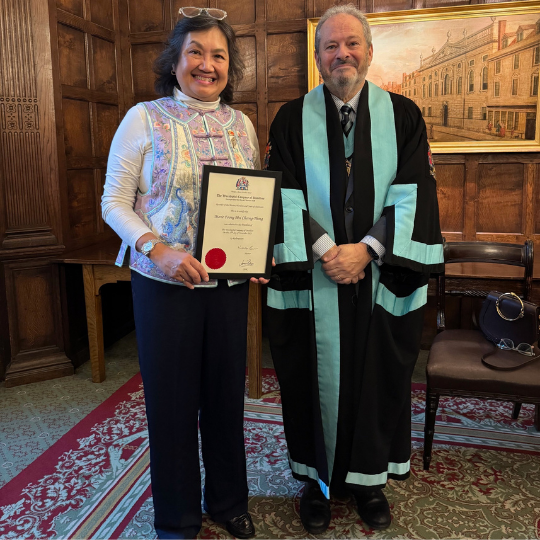
The Worshipful Company of Distillers
As an educator whose students consistently achieve top distinctions, what do you see as the biggest obstacles Western professionals face when approaching sake, shochu, and Asian spirits—and how do you help them move beyond those barriers?
Patience is certainly a virtue!!
Having taught the WSET sake courses for the last 10 years, the biggest initial difficulty is pronouncing words, a challenge for most, but once stuck fast in the brain, the job is done. Teaching novices to read and write is certainly challenging but with patience, repetition and just persistence I have conquered this with my students. The next biggest hurdle is translating, reading and writing Chinese characters, Japanese Kanji, Hiragana and Katakana. Then there is Korean, Thai and Vietnamese!! Having said that a challenge is always worth the effort. Today thousands of students have achieved the WSET3 Sake award so no excuses to be made. The Chinese, Taiwanese and Koreans have improved their labelling so language is becoming less problematic. With decent translating apps (including google and god forbid - the dreaded AI Chat GTP) and more Asian drinks specialists arising, this problem is really no longer an issue. In fact I now have the reverse teaching Asian students the course in English - explaining production and tasting terms!

Matsuo o no Taisha shrine Matsumoto, Kyoto japan
Inauguration of sake samurai
Your work spans education, journalism, research, judging, and cultural ambassadorship across continents. When presenting indigenous food and drink traditions to a global audience, how do you navigate the line between cultural authenticity and accessibility?
Experiences make life interesting.
With over 50 years travelling the continents, living in different countries and immersing myself, it’s been a pleasure disseminating my experiences, knowledge and almost comical stories to others. My database of over 8000 ingredients catalogued and photographed helps me, together with people I have met, interviewed, had meals with or just chatting over a local drink. I have scoured local markets and always make it a point to study food and drink in supermarkets all over the world to understand local life. A hobby I guess.
One of my most unforgettable experiences being sat next to the Governor of a Japanese prefecture. A lovely chap who really enjoyed his food. Fabulous sashimi and sushi with the prize morsel being the raw liver of the humble archaic but terribly expensive Abalone. Sat on its own in a delicately handpainted glass choko, this dark greyish black blob anointed with a tiny green herbed crown, gently steeped in dashi stared back at me all evening. Hoping this gentleman would forgive me for not attempting to ingest I left this on the side. “Oishi ne”, the Governor smiled and raised his choko of sake to me indicating gently that it would be terribly rude to leave it, in a very discrete Japanese gesture. With no husband with me - my personal “taster” and “ingester” - I had no choice but to take a good swig of sake, put the raw liver into my mouth and swallow without chewing. “Kanpai!!!”, etched in my mind forever! Lots of other food stories including a scorpion and tequila chaser, sperm duct of the cod, intestine of the sea cucumber to name but a few. Makes Durian an absolute nursery food!!

Mousquetaire inauguration in London
With new books underway and Asian spirits enjoying growing global attention, what feels most exciting about this moment in your career? Looking ahead, where do you see the greatest potential for Asian beverages on the world stage?
I’ve had different careers - to be exact every ten years, my career changed..
Not quite a career.. my life these days is more about giving back. Ive had a brilliant run in the last 20 years building a life in the drinks and food world (after years of kids school runs and attending non stop international fencing competitions, recitals and orchestra concerts). I now do a lot of charity work including running the British Sake Association as President with my ten committee members, all of whom are volunteers and I Chair the Baijiu Association.
It’s been an exhilarating couple of years with recognitions. Being made a Sake Samurai joining 100 odd fellow Samurais worldwide is certainly humbling. Shortly after I was inaugurated as a Mousquetaire d’Armagnac and a Rectifier of the Gin Guild. More recently I was given the Freedom of the City of London and the Worshipful Company of Distillers. Very honoured. Its been so worthwhile doing what I do and have done. Having written, taught and researched, the most comforting and also exciting moments for me is that I have been recognised and rewarded in so many ways, met so many new friends and colleagues and of course to be part of this amazing drinks community WORLDWIDE.
Earned my ambassadorship for Sauce aroma, Strong aroma as well as Light aroma Baijiu in the last 12 months. Judged in two large competitions based in China. Will be judging in Hiroshima Japan this coming May. These visits have opened my eyes wide but like the rest of the world, the drinks market is seeing drastic change.
The Asian spirits sector is still relatively new to the rest of the world. While we in the West are discovering and learning, the East is eager to teach and promote. When we talk of Asian spirits I include the wonderful spirits from lesser known countries like the Philippines, Vietnam, Laos, Thailand and even India. Not just China, Japan and Korea. Today we see interesting gins and whiskies coming from Singapore and even a blended whisky from Malaysia and lovely one from Bhutan. Sadly, China now disapproves of alcohol served at government banquets and its no longer seen appropriate to eat and drink alcohol as openly. Baijiu remains the market leader (just) with Moutai and Wuliangye in the top company list.
The world is changing and may the East and West merge happily to include diversity and inclusivity in the spirit world (of the imbibing kind). There is still so much to learn and disseminate making the world stage a bigger and more interesting arena.
Editor Marinos Skolarikos February 3 2026
Photo Credit: Marie Cheong Thong