CADIZ,
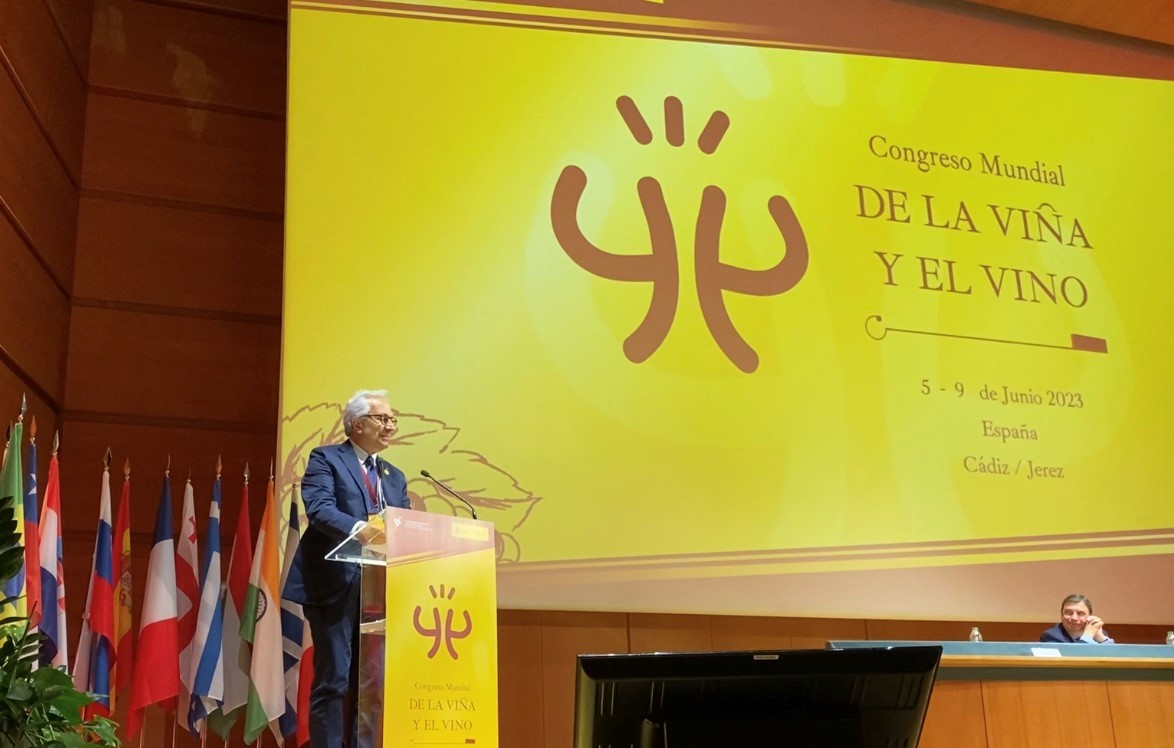
The speech of Luigi Moio, president of the International Organization of Vine and Wine, at the Congress n. 44 in Cadiz (5-9 June)
Reiterate that wine is a direct product of an agricultural act and linked to the territory, unlike other beverages, alcoholic and not only, and that its "intelligent", moderate consumption, in combination with meals and in a context of healthy lifestyle, has a positive value. Learning from history and the recent past, when also due to the lack of an authoritative scientific reference, wine itself, cultural drink par excellence, has been cornered by counterproductive and scientifically unmotivated choices. As in part it is likely to happen even today. And from which it must be defended, with the power of science. Also in view of the centenary of the birth of the International Organization of Vine and Wine (OIV), on November 29, 1924, with 2024 that wants to be proclaimed "International Year of Vine and Wine", which would have a high symbolic value, but not only. These are the reflections at the center of the opening speech of the World Congress of Vine and Wine n. 44, staged in Cadiz, Spain, from today to June 9, in the words of Professor Luigi Moio, president of the International Organization of Vine and Wine (OIV).
"I have the privilege and the great honor of welcoming you to Spain, a country that in a century of life of the OIV, hosts us for the sixth time. But this year's invitation has something special: the Congress - said Moio - is the one that will conclude the first hundred years, ferrying our organization into the next hundred. Therefore, as OIV President, I feel the duty and responsibility to express some brief considerations on this particular moment and on the crucial role that the Kingdom of Spain has played from the beginning in the birth of the OIV".
At the end of the nineteenth century, with the arrival of phylloxera, recalls Moio, the urgency of coordination and international comparison between scientific experts from different countries arose. In 1874 an international scientific commission was created which initiated and encouraged studies on the biology and epidemiology of the insect. "Subsequently, as we all know, with strictly biological criteria, the problem was brilliantly solved." But, after the phylloxera disaster, in addition to the drama of the First World War, European winemakers, who represented 90% of world production, found themselves facing other problems, such as "the uncontrolled increase in fraud with the production and trade of adulterated and manipulated beverages that were called wine; the lack of a common definition of wine that would allow unified regulatory control to regulate trade and combat fraud; the blaming of wine, included in the list of spirits to be banned, in the decade of prohibition in the United States, from 1920 to 1930; the lack of an international body for comparison and study of the various technical-scientific problems of the wine supply chain.
So it was that, exactly a century ago, on June 4, 1923, the high representatives of Spain, France, Italy, Portugal and Greece gathered in Paris for an International Ministerial Conference of the wine-exporting countries".
And as Moio recalled, the fundamental points addressed by the "Constituent Assembly" of the OIV 100 years ago are largely very current. "First of all, to study and develop suitable measures to make known and appreciateThe positive value of moderate consumption of wine, in combination with meals and in a context of healthy lifestyle. With regard to this first objective, it should be remembered that the first article of the OIV's articles of association, dating back to 1924, stated that the organization had to: "collect, study and publish information demonstrating the beneficial effects of wine". In fact, to give an immediate and concrete impulse to the dissemination and promotion of wine culture, in 1930 "le Prix de l'Oiv" was established. An award that at that time was entitled: "The Truth About Wine" and that today is the oldest in the world. In 77 editions it has been awarded to the authors of more than 800 editorial works. The second point under discussion was aimed at examining the regulations adopted in the various countries on the definition of wine, in order to prepare a common definition of wine, which is still valid today - added Moio - and encourage the development and adoption of analytical and regulatory procedures aimed at guaranteeing the purity, genuineness and integrity of wine. Finally, the third objective was to create an International Wine Office to devise agreements on scientific bases to be transmitted as recommendations to the Member States in order to facilitate the harmonization of their policies and facilitate international trade".
And so, history goes, on June 6, 1923, after three days of work, the five delegations agreed on the principles discussed, approving them in a second diplomatic conference held from June 30 to July 5, 1924, and to which the countries also joined: Austria, Hungary, Luxembourg, Tunisia, Chile and Mexico. The two conferences finally led to the signing of the agreement that sanctioned the establishment of the OIV: on November 29, 1924.
"Spain, therefore, from the beginning - recalls President Luigi Moio - participated in the construction of what later became the International Organization of Vine and Wine". This is testified, among other things, by the two Spanish presidents of the OIV, engineer Eladio Asensio Villa, the first non-French to preside over the OIV, from 1963 to 1968; and Dr. Gabriel Yravedra, president from 1991 to 1994, who died recently, but also Pau Roca, first Spanish general director, still in office, whom Moio wanted to mention thanking him and above all paying tribute to his unstoppable work that with great passion and determination carries out in the exclusive interest of the growth of the OIV which, Moio recalled, It is from Spain that the sequence of events for the celebrations of the centenary of the Organization will begin, with the proposal, which will be formulated during the general assembly next Friday, to proclaim the centenary year "International Year of Vine and Wine", which will close on November 29, 2024, the exact day of the centenary. "The announcement of an international year of vineyard and wine - added Moio - in addition to the high historical value, aims to stimulate and animate meetings and debates of a scientific, technical and cultural nature in all wine countries of the world under the general theme: "The vineyard and the wine of tomorrow".
"Theme that is in perfect harmony with the topics covered in this congress - explained the president Oiv Luigi Moio - on new information technologies in viticulture and oenologyIA. In fact, digital information has rapidly entered the entire wine supply chain, from production to consumer, offering surprising opportunities for the development of increasingly precise and sustainable production processes and for the dissemination of complete and correct information in real time. But today the wine sector, unfortunately, is experiencing alarming concerns. The current and especially future society could evolve towards models that would risk questioning the legitimacy of wine, especially due to changes in the perception of alcoholic beverages. A new wave of neo-prohibition could lead to a radical change in wine consumption, both in terms of ways and quantities, leading to a rapid decrease in consumption within a few generations. Therefore, the world of wine needs to be reassured and protected, because the cultural space that this drink has occupied for millennia in society could risk incurring a real delegitimization".
"It is necessary, therefore, to reiterate in every place that wine is a drink different from all other alcoholic beverages, both for its profound historical and cultural values, and for the way in which it is taken, that is, in small sips that slowly accompany food. It is in this way that wine, like no other drink in the world, completes and amplifies the sensory perception of food, contributing to the search for bodily, immaterial and intellectual happiness of men. The times we are living in will inevitably lead to radical changes both in production, especially in the vineyard, and in the promotion of responsible consumption of this drink, but fortunately the high cultural value of wine, at least in traditionally producing countries, cannot prevent us from supporting an "intelligent" consumption with serious education and training programs. Finally, there is another important aspect that is very close to my heart. We must never forget to reaffirm in every context that wine is the result of an agricultural act directly linked to the production territories and that viticulture is a vital garrison for many territories whose importance is becoming increasingly evident in this particular period of climatic upheaval. The link with the land is the great strength of wine and this can only be the case in the future as it is precisely this exceptionality that makes it an entirely agricultural product and consequently totally integrated into food systems. All this and many other originality of wine must be explained and told, because as we are perceiving, after a hundred years history repeats itself and wine, once again, has a strong need to be defended, protected and guarded in its integrity. The scientific world is fully involved and must absolutely take charge of it. We just hope to have the time to do it!
Long live wine, long live the International Organization of Vine and Wine, long live Spain!", concluded President Luigi Moio.
Source: Winenews.it
OIV