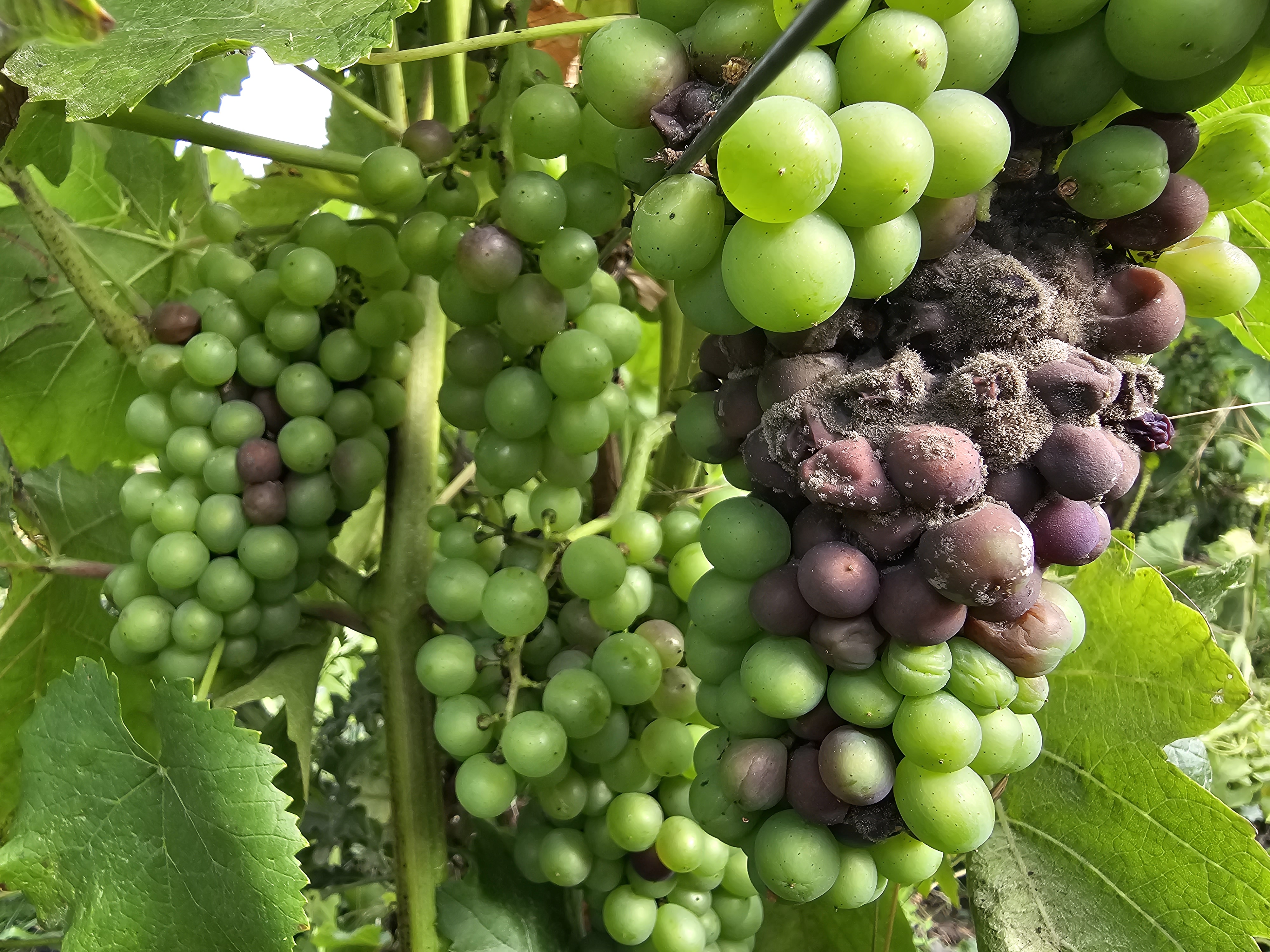
In Champagne the vineyards attacked by mold (ph: Olivier Zebic via Twitter)
Harvest estimates have always been valid for what they are worth. Forecasts, almost always made too early, and as such, especially in times when the climatic trend is far from regular, susceptible to being distorted. Sometimes, fortunately, for the better, as happened in 2022, when after a long summer drought the harvest, finally, synthesizing to the maximum, was saved from the rains of mid-August. Sometimes, unfortunately, for the worse. As seems to happen now, at least in France, where the estimates of the Transalpine Ministry of Agriculture at the beginning of August (between 44 and 47 million hectoliters, which would put France at the top of the "ranking" of the world's largest producers, given the Italian estimates of 43 million hectoliters, according to Coldiretti), could be considerably different from the final budget. The great heat wave that is hitting the Belpaese, in fact, is also a common issue beyond the Alps, where in these days temperatures have been in many areas, and for a long time, between 40 and 42 degrees, with peaks of 43 (with red alert in 19 "departments" of the country). And this, as reported by the magazine French Vitisphere, will have some impact on the harvest and yields, and also on logistics, as explained by Jacques Rousseau, head of the viticulture department "Groupe Icv", one of the largest wine consulting companies in France.
"We had already noticed a strong acceleration in maturation last week. The heat wave does not help. The potential grades increase by two points per week and some wineries are forced to reorganize their harvest programs to produce, for example, rosé".
The maturations are getting closer and closer, making it even more difficult to organize the harvest. "In the parcel network we monitor in the Gard, there is on average only one degree of difference between all grape varieties and all sectors, whether they are early or late ripening. In the Saint-Chinian area, the latest analyzes give 13% for all grapes. This complicates logistics, taking into account that wineries do not have scalable reception capabilities."
In the Vallée-du-Rhône, Provence, Gard and eastern Hérault, the berries had good acidity and high levels of malic acid. "This is not the case in vineyards affected by drought, in the western Hérault, in eastern Aude and especially in the eastern Pyrenees," continues Jacques Rousseau.
Some problems can also be seen in Bordeaux, as reported in recent days by the newspaper "Le Figaro Vin", where the harvest for the Cremant has already begun, but where they are dealing with mold that, according to the Chamber of Agriculture of Nouvelle-Aquitaine, are affected more or less
intensely 90% of the vineyards. "The situation is very difficult for our winemakers. Some have lost almost everything in their companies. There is a lot of anguish," Stéphane Gabard, president of the Syndicat des AOC Bordeaux et Bordeaux Supérieur, told AFP.
The real impact in the largest vineyard in France (110,000 hectares) is to be estimated. "Nobody knows: we thought we would have a very large harvest at the beginning of June and a very small one in mid-July, and now for the Crémant it is better than we thought," comments Christophe Chateau, director of communications at the Conseil Interprofessionnel du Vin de Bordeaux (Civb). "It's It is clear that with mold a large part of the crop has been lost", confirms Stéphane Gabard, who believes plausible losses of between 20 and 50%.
And the mold, and in particular the "botritys cinerea", reports Vitisphere, is manifesting itself in an important way also in Champagne, favored by the climate and the compactness of the bunches, especially in the unpruned vineyards. In the territory of the famous and prestigious bubbles we still hope for a good harvest, even if the molds, according to official counts, would have already affected 5% of the vineyard, with a situation that, with a harvest that will not begin before 5-6 September, seems destined to worsen, with the alternation of rains and heat peaks. And with already one in five bunches of Chardonnay affected, in the westernmost part of the territory, according to Olivier Zebic, consultant winemaker and agronomist specialized in the Champagne region.
In short, a complex situation in France. As well as in Italy, where net of the estimates so far disseminated by trade associations, Consortia and not only, the only certainty is that the year will be decidedly complicated. New official estimates, provided by Unione Italiana Vini, Assoenologi and Ismea, will arrive on September 12th, when the harvest will have come more alive and something more can be said. While for a more concrete and realistic judgment, WineNews will also wait a few more days, waiting for a good part of the grapes, at least for the white varieties to be in the cellar, feeling the pulse, as we have been doing for years, to producers and oenologists, who live the vineyard in first person.