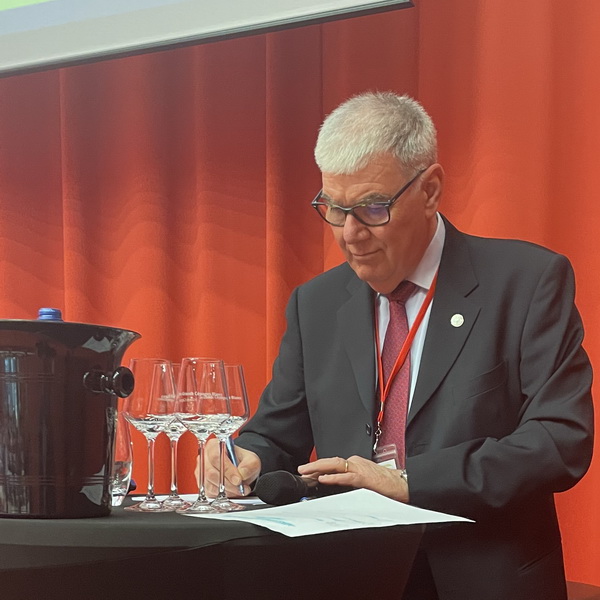
Hello everyone and thank you for coming.
Today we'd like to introduce you to the Collio or Collio Goriziano appellation.
Geographically, we're in the far north-east of the Italian peninsula, on the border with Slovenia.
The region is called Friuli-Venezia Giulia and the province is Gorizia. It's a very small, circumscribed area.
This area, like the whole Friuli-Venezia Giulia, is protected to the north by the Carnic Alps and the Julian Alps, which are the last eastern offshoots of the Alpine chain, and this protection is very important because it stops the cold winds coming from the north. To the south, the region benefits from the temperate influence of the Adriatic Sea, which is only a dozen kilometres away. The environmental conditions are therefore extremely favourable for growing vines. The soil is characterised by the Friulian "ponca", a stratification between marl and sandstone known as flysch.

Historically, Collio wine originated around twenty-one centuries ago, when the Romans conquered these territories and brought vines with them, as was their custom wherever they arrived. Since then, the area has always been known and famous for its production of wine grapes (and cherries, which not many people know). Until the end of the 18th century, the region was under the rule of the Serenissima Republic of Venice, then, with a very short Napoleonic interval, domination passed to the Austro-Hungarian Empire. The Viennese court greatly appreciated the wines produced in Collio (as well as the cherries), as did those produced in Tokaji in Hungary. From a historical point of view, it should also be remembered that the region was a border area during the First World War, the scene of many epic battles, and then partially at the end of the Second World War, when the Collio was cut in two by the new geopolitical situation with the former Yugoslavia as far as the town of Gorizia, which was in fact divided into Gorizia and Nova Gorica. From the end of the Second World War to the dissolution of the former Yugoslavia, the town of Gorizia formed the border with the Soviet bloc. This historical aspect is very important in understanding the development of winegrowing in the region over the last 70 years.
Modern Italian viticulture was born in the 1960s. It is widely acknowledged that the two leading regions were Tuscany for red wines and Friuli for white wines. Until the 1960s, Italian winegrowing was very massive (Italy has always been, along with France, the country with the highest per capita production and consumption), essentially devoted to self-consumption and the production of wine as a cheap source of calories. Of course, Italy has always produced great wines in the past and in different regions, but the fall in consumption from the 1970s onwards (141 litres per capita in 1971 and 39 litres in 2021) has directed production towards better quality wines for consumption that has become simply hedonistic. Wine for pleasure and enjoyment, not for food.
In Collio, there are many white vines, some local or indigenous, others that have become typical and still others imported. Then there are the red grapes, but let's not talk about that because we're at the Mondial des vins blancs!
Then there's aromatic grape varietals like Gewurztraminer and Riesling, and semi-aromatic ones like Muller Thurgau, Sauvignon, then Picolit, Pinot Bianco, Chardonnay, and finally the region's signature varieties like Malvasia, Pinot Grigio, Friulano and Ribolla.
Today we'll be tasting four wines, all in the Collio identity bottle and all bearing the Consortium label. Only at the end will we mention the names of the producers. In fact, today we are talking mainly about the territory and only marginally about the producers.
The wines are as follows:
Collio Ribolla Gialla (100% Ribolla gialla grape variety) a beautiful yellow colour with greenish highlights, a floral nose, a taste with good acidity, refreshing.
Collio Bianco (a typical regional blend). In Collio bianco, each producer can adopt his own recipe for a wine bearing the name Collio blanc without any indication of the grape variety. It is up to the producer to compose the wine according to his own sensibility, taste and feeling for Collio. Here we have a strong yellow colour, a full nose of flowers and fruit, and a full, authoritative, fairly long palate.
Collio Friulano (100% tocai friulano). The most famous of the Friulian grape varieties, the wine that is most reminiscent of Friuli, the wine that identifies Friuli and is identified with Friuli. In Collio, Friulano gives a bright yellow colour, a full, floral nose and a distinctive almond flavour.
Collio Pinot Grigio (100% pinot grigio grape variety in the coppery/venetian "ramato" version)
This wine is special. If you look at the bunch in the photo (Credits Carola Nitsch), it has a brown colour when ripe, I'd say tending towards grey. Now, if we do a white vinification, the one without contact with the skins, the wine will be white; if we do a red fermentation, the one with the skins for a certain time, we'll have an old-fashioned, Venetian, copper-pink wine. Credits Carola Nitsch.
Pinot grigio ramato has a fairly intense, rich and deep nose. The taste is complex, moderately mineral and very long.
I don't like to explain wines or describe them in detail. Firstly, because this audience is made up of professionals who don't need to be told about the scent of lime blossom or acacia, and secondly because everyone has their own personal perception.
At the end of the tasting, if you wish, we can talk about it together.
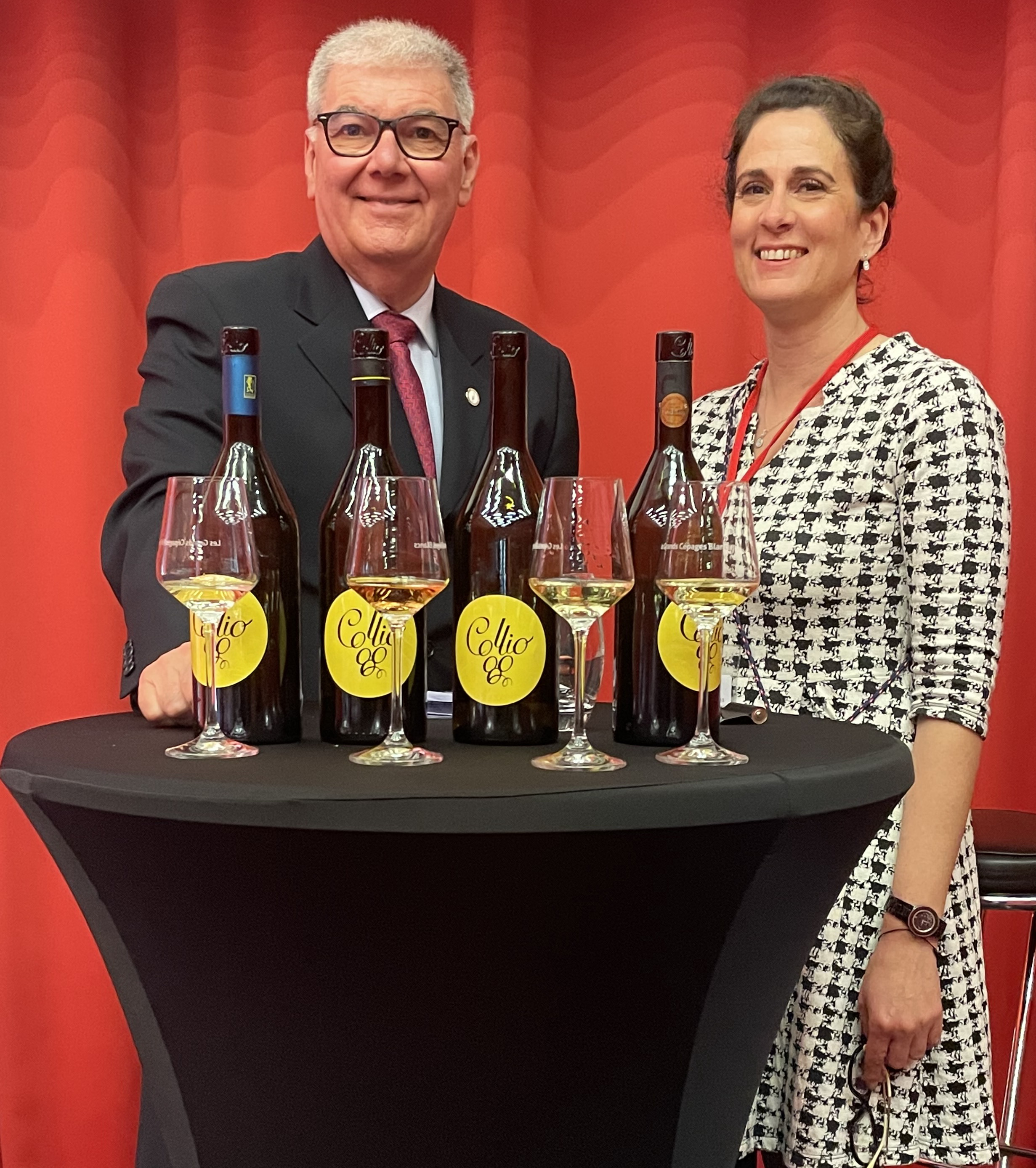
Francesco Bonfio and Julie Reisser responsible person for the Masterclasses
I'd like to conclude by mentioning the gastronomy of the Collio region, because the border situation and the cultural exchanges that have resulted from it have given rise to a cuisine with Mitteleuropean influences, with savoury-sweet combinations, with Slavic accents, and therefore particularly interesting. What's more, the region's favourable location has also led to cultural cross-fertilisation between produce from the land, sea, forest and hills. It all adds up to a very interesting and original cuisine.
Thank you all for your attention.
Fransesco Bonfio is President of a wine association, did the honor of joining the Jury of the Mondial des Vins Blancs Strasbourg. It is precisely this association, the AEPI, the variety of its missions, its activities and projects that we wish to highlight. AEPI is the acronym of the Association of “Enotecari” Italian Professionals. Today is the ownwer of wine Shop called Enoteca Piccolomini inside the famous bar Nannini in the most central location in Siena, 50 meters off Piazza del Campo.”