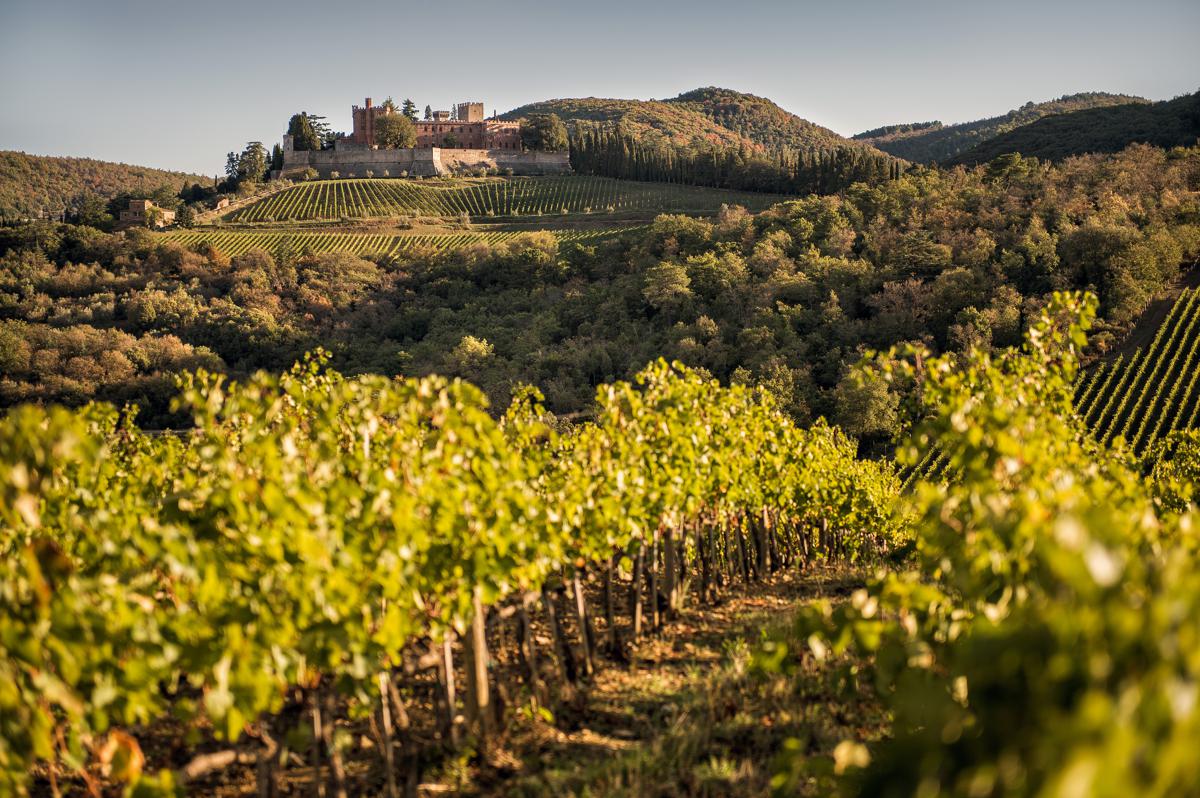
The Castle of Brolio: a symbolic place of the Chianti Classico
territory
Ricasoli is the most representative winery in the Chianti Classico area. Between rolling hills, velvety valleys and dense oak and chestnut woods, the 1200 hectares of property include about 240 hectares of vineyards and 26 of olive trees, in a continuous succession of colors and shades around the Castello di Brolio, in the municipality of Gaiole in Chianti.
In this most central portion of Tuscany, since 1993 Baron Francesco Ricasoli has been leading the company towards new challenges, with the deepest respect for his illustrious ancestors who made that same territory great, first of all Bettino Ricasoli.
Francesco Ricasoli, the current owner and President, created new ideas and new concepts to experience the vineyards in a sustainable way: the continuous study of the soils and the clonal selection of Sangiovese di Brolio are among his greatest passions, so much so that he wanted to totally renovate the vineyards and define the complete mapping of the same.
The new labels are, therefore, the expression of the many researches conducted with the same scientific rigor of the great ancestor but with the contemporary spirit of those who pick up the baton and carry it forward with new energy.
... I look out from the walls of the Castle and look at this view: I close my eyes and imagine a painting of the Renaissance. It's a bit like being at the Uffizi and contemplating a work of art composed of the combination of man and nature.
- Francesco Ricasoli -
From Longobard origins to after Cavour
The Ricasoli family appeared among the feudal noble dignitaries in the court of Emperor Charlemagne. From the thirteenth century onwards the branches of the family multiplied and then reunited once more in the late 1700s, early 1800s.
With their armies, generations of Ricasoli nobles have charted the course of history against the backdrop of Brolio Castle, defending Florence since 1200, from the eternal battles against Siena until the unity of Italy. Bettino Ricasoli, the Iron Baron, was twice Prime Minister of the newly united Italy after Cavour.
HISTORY
Ricasoli and the birth of Chianti wine
The history of the Ricasoli family has been linked to wine since 1141, when there is written testimony attesting that the Ricasoli family already possessed Brolio Castle. After centuries defending their lands and feudal sovereignty, the Ricasoli family understood the great potential of the Brolio territory and were among the first to dedicate themselves to the improvement of agriculture and vineyards. In fact, the family tree, reproduced in a print from 1584, is one of the first images of the Chianti area.
Interesting documents from the late 1600s report the first exports to Amsterdam and England, whereas at the start of the 1900s, the wines from Brolio were well known and appreciated, requested and exported all over the world: from China to Saudi Arabia, from South Africa to Guatemala, from Costa Rica to the one-time British colonies in Africa. Most especially, in 1872 Baron Bettino Ricasoli (1809 – 1880), illustrious politician and visionary wine entrepreneur, originated the formula for Chianti wine, now called Chianti Classico.
THE RICASOLI SOUL
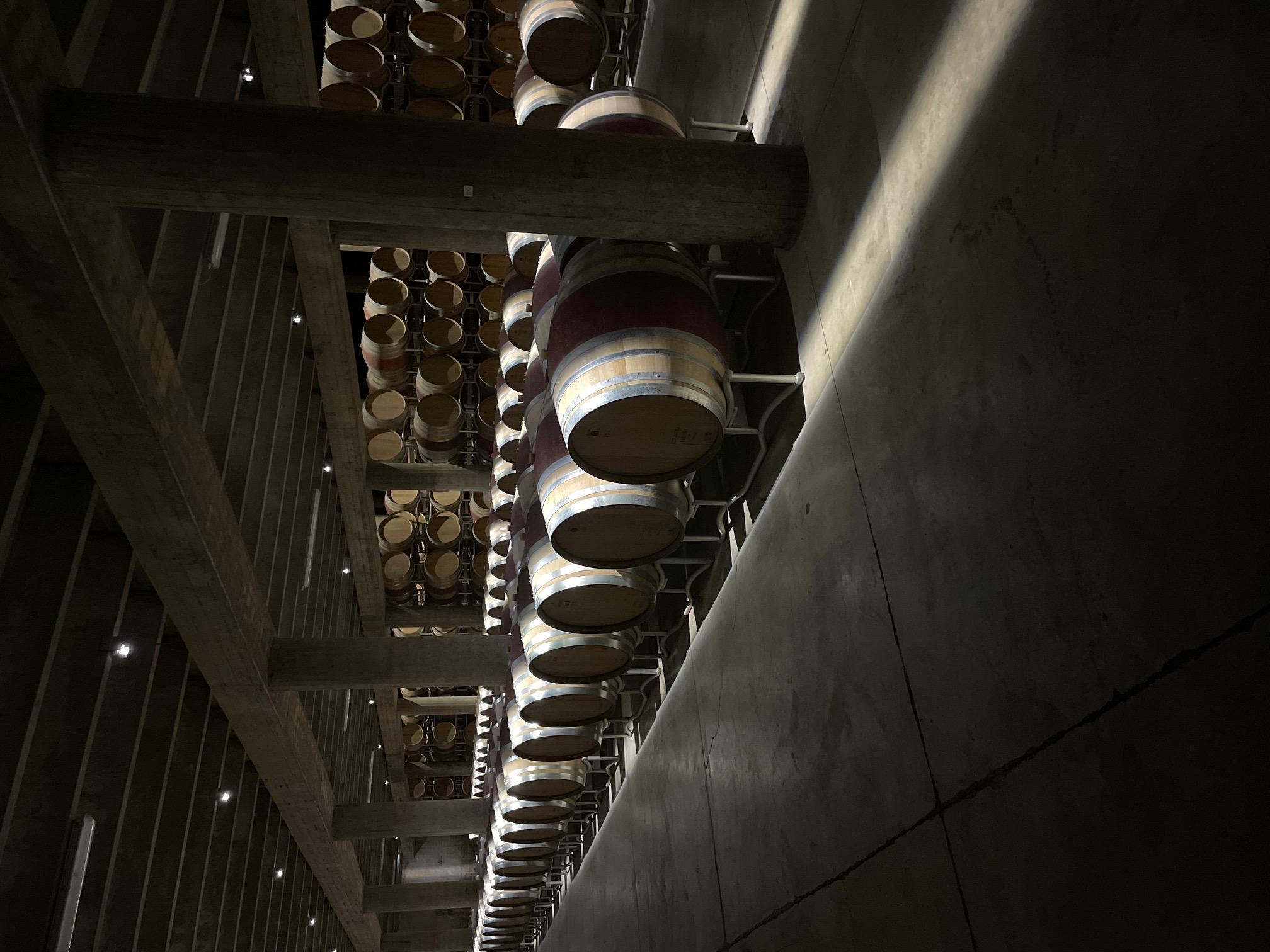
The vat room is located at the foot of Castello di Brolio, separated from the main body of the winery, and is used exclusively for winemaking. The renovation of the ancient cellars was carried out partly following a careful aesthetic and functional recovery of the original nineteenth-century rooms, and partly seeking a modern and technologically advanced organization of the spaces.
The harvest is carried out separately for each parcel of vineyard; once harvested, the grapes are transported to the cellar in containers with a maximum load of 200 kg and then begin a vinification process in small steel vats. These choices allow a careful control of the fermentation process, as well as keeping the characteristics of each individual vineyard parcel separate.
The experiments related to the knowledge of the territory have led us to the choice of separate vinifications even within the same parcel, depending on the morphological similarities of the subsoil; The structure of the winemaking cellar is designed in such a way that the filling process of the vats takes place by gravity and, consequently, also allows a delicate fulling, such as to obtain the extraction of the noblest substances from the skins.

At the end of the fermentation process, the wines are transferred to barrels, tonneaux and oak barriques at the aging cellars. Frequent laboratory checks accompany Ricasoli wines throughout their evolution up to the long (sometimes very long) aging in the bottle that takes place in special temperature-controlled rooms, and then leaves for the many destinations in the four corners of the world.
VINEYARDS AND GRAPE VARIETIES
Territorial extension and varietal wealth
Ricasoli’s vineyards are all on hills, with altitudes ranging from 220 to 500 meters above sea level, mostly with a south, southwest exposure. The climate is Mediterranean, with concentrated rainfall in spring and autumn (about 32 inches per year), mild winters with rare snowfalls, and hot, dry summers.

Sangiovese is the reigning variety; here it finds an ideal environment where it can develop all its natural potential. Attention to the terroir guides choices at Ricasoli, such as the most suitable variety to plant; the most appropriate rootstock; correct row orientation; and best agronomic practices.
“Each wine we produce has a very independent personality, though all are produced in the same territory. The credit lies in the multifaceted soils, altitudes and microclimates that allow us to bring out the true nature of the Brolio Terroir”.
- Francesco Ricasoli -
Soil Characteristics at Brolio
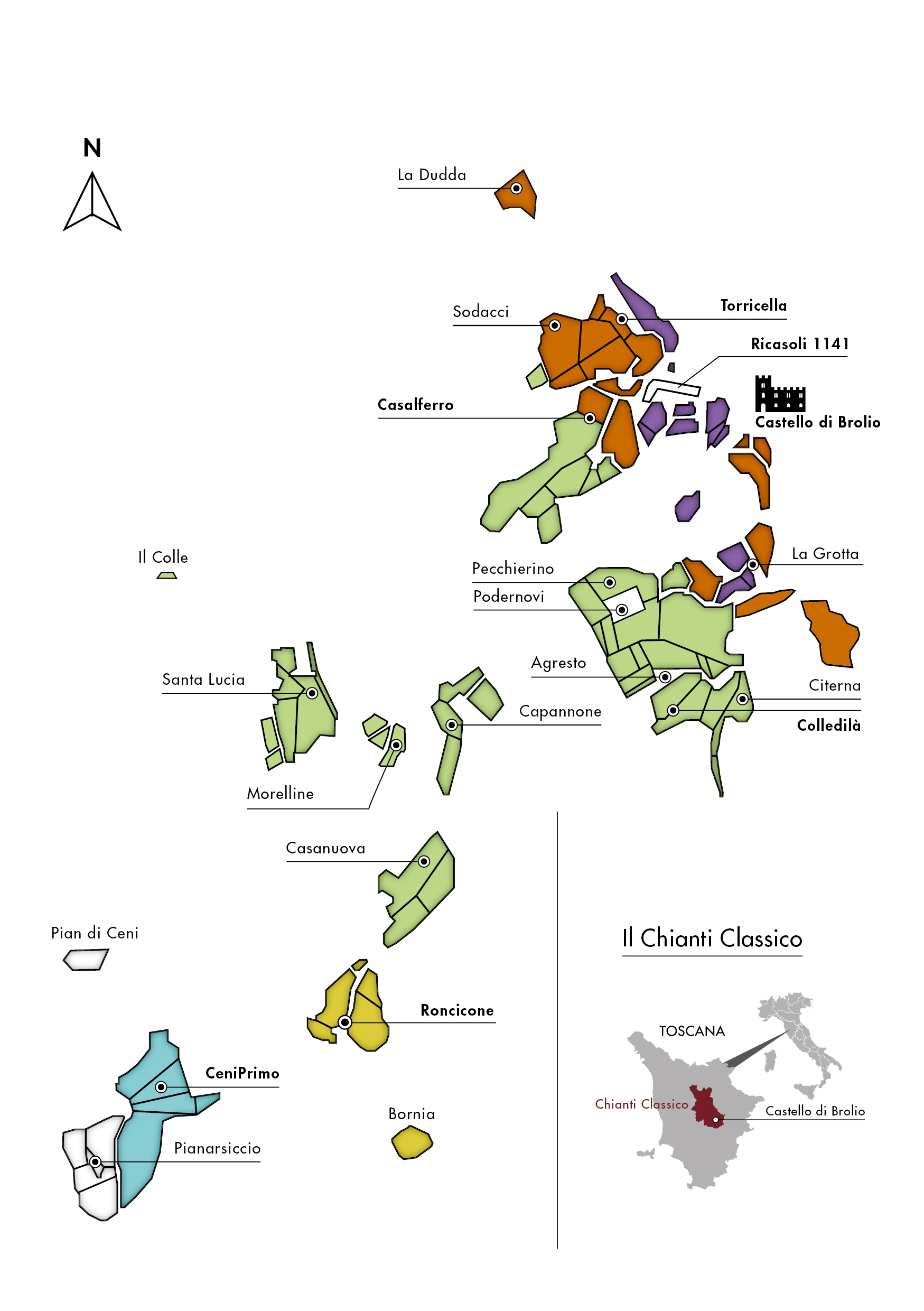
The main aim of this zonation project was to master the essential assets of the estate and land in an effort to orient both agronomic and enological choices towards best management practices to exalt modern precision in viticulture and sustainability. The zoning research that Francesco Ricasoli implemented, identified nineteen different soil types at Brolio, indicating the varied soil composition found in much of the Chianti Classico area. The wide variety typical of the Brolio vineyards is evident even to the naked eye. Wine vinified plot-by-plot has allowed us to identify areas with particular qualities and potentials and from this, wines of structure and distinctive flavor are produced. Some Crus of exceptional quality have been produced in thanks to the company’s propensity for the Cru concept.
The estate can be divided into at least five principal soil substrates:
MACIGNO DEL CHIANTI FORMATION
Soil commonly called Arenarie, composed of sand and rocks, well drained and containing little organic matter. High elevations ranging from 400 to 500 meters above sea level and variable exposure, vine-density from 5,500 to 6,600 plants per hectare. Vines: Sangiovese, Merlot, Chardonnay. The soils yield complex and well-structured wines. This area is especially well suited to viticulture and includes part of the Casalferro vineyard.
SCAGLIA TOSCANA
Also called Brolio’s argillite or Galestro (schist-based soil). The soils are very thin and the geological formations found in this area are the Scaglia Toscana and the Macigno del Chianti Formation. The altitude ranges from 400 to 500 meters above sea level, vineyard exposure to the west, northwest, and south; vine- density from 5,500 to 6,600 plants per hectare. Vines: Sangiovese. Wine with high tannin content, complex structure, and intense minerality.
MONTE MORELLO FORMATION
Limestone, commonly called Alberese. Calcareous clay soil, rocky, rich in calcium carbonate and clay and poor in organic matter. The altitude ranges from 350 to 390 meters above sea level, southeast, southern, western exposure. Vines: predominantly Sangiovese, Cabernet Sauvignon, and Merlot; vine-density is 6,600 plants per hectare. Wines: excellent structure, body, and persistence, with soft and sweet tannins. The area is ideal for Sangiovese, and includes the Colledilà vineyard.
MARINE DEPOSIT
Pliocene marine sediments, with sandy deposits and rocks smoothed by the action of the sea, and clay at deeper levels. Good levels of organic matter. Altitudes in this area range from 300 to 350 meters above sea level, variable exposure, vine-density from 5,500 to 6,600 plants per hectare. Vines: predominantly Sangiovese. Wines produced from these soils are fresh, with spicy notes, elegant acidity and distinct minerality. This area includes part of the Roncicone vineyard.
ANCIENT FLUVIAL TERRACE
Fluvial-lacustrine deposits formed in the Pliocene-Pleistocene period. The deposits are silty, poorly structured, with clay. The altitude varies between 260 to 300 meters above sea level, southwest exposure. Vines: Sangiovese and Cabernet Sauvignon, vine-density from 5,500 to 6,600 plants per hectare. Wines with a complex range of aromas, well-structured, high tannin content, body, and persistence. This area includes part of the CeniPrimo vineyard.
SUSTAINABILITY
Since 1141, the Ricasoli family has been inextricably linked to Brolio and its lands, an unspoiled corner of central Tuscany, in the heart of Chianti Classico, where the purity and beauty of the landscape are the result of hard and skillful work, carried out generation after generation. Aware of its role as guardian of the integrity of this extraordinary territory for future generations, Ricasoli aims at producing quality wines that are increasingly respectful of the environment.
The goal is to always improve. From this perspective, the Certification is not an objective but an important step in a concrete and constant commitment that has ancient roots but also an eye to the future. We have chosen the Equalitas Certification standard which, in addition to the environmental sustainability, it also stresses the ethical, social and economic aspects which are equally important to us.
ENVIRONMENTAL SUSTAINABILITY
For many years, Ricasoli has been practicing an increasingly nature-friendly agriculture. We have kept away from chemical weeding and pesticides and opted for systems of fertilization and parasite control that are even stricter than the principles of organic farming.
The 1,200 hectares of the property are a hymn to biodiversity: 70% of this large area is covered with woods and Mediterranean scrub characterized by an extraordinary variety of animal and plant species. A huge green lung that is maintained today as in the past, following a centuries-old tradition.
While in the woods lives a rich fauna that thrives thanks to the healthiness of the environment, the sustainable practices in the vineyard favour the presence and work of pollinating insects and that of microorganisms and invertebrates, which enrich the soils.
Ricasoli is today the first employer in its county, Gaiole in Chianti. The resources and skills employed in the company are almost exclusively local, thus, the communities living in either the countryside or some isolated nearby places are kept alive. The stories of entire families are intertwined with those of the company and, time and again, crafts and professions have been handed down, like a passing of the baton, from parents to children.
The love for the territory where the Ricasoli family has its roots, furthermore reflects in the scrupulous care of the man-made landscape of Brolio and its peculiarities, in full respect of the local ancient peasant culture and of the Chianti tradition, such as the gravel roads, the cypress-lined alleys and the dry stone walls –listed in the UNESCO Intangible Cultural Heritage of Humanity.
With this in mind, we encourage sustainable tourism: the call of Brolio Castle and its wines brings every year thousands of visitors from all over the world. We are committed to offering them an authentic experience of the territory, a truly enriching exchange with the places they visit and their inhabitants, from slow tourism to the tasting of wines and 0km food.
THE WINES
During our visit last January we had an excellent wine tasting with Eleonora Rudino and Elisabetta Ricasoli

CASTELLO DI BROLIO 2020
CHIANTI CLASSICO GRAN SELEZIONE GAIOLE
Castello di Brolio is the flagship wine created from a meticulous selection of estate-grown grapes. Produced only in the best years, this is an iconic wine which will leave a lasting impression. Its most salient features are the concentration and tannic structure. This prized blend, carefully aged in the cellars at Brolio Castle, warms hearts and souls and offers extraordinary taste which elegance and freshness stands even the test of many years of ageing.
BROLIO 2022 Chianti Classico Docg GRAPE VARIETIES Sangiovese 95% , Colorino 5%
BROLIO BETTINO 2021 CHIANTI CLASSICO
An elegant wine with character, Brollio Bettino stands out for its generous percentage of the beloved Sangiovese grape and for its particular vinification, without filtration and in large wooden barrels, in the manner of Bettino.
100% Sangiovese
BROLIO RISERVA 2020
Chianti Classico Docg Riserva
100% Sangiovese
Overall, we can state that 2018 was a complex harvest due to the climate trends, which tended to be more humid than average in the past, but with excellent summer temperatures and a very dry period in the months of September and October.

COLLEDILÀ 2020
Chianti Classico Docg Gran Selezione Gaiole
100% Sangiovese
The greatest expression of knowledge of the territory, the cru gathers the characteristics of the vineyard
CASTELLO di BROLIO SANBARNABA 2020
100% Trebbiano
Vin Bianco Toscana IGT
The Trebbiano of Castello di Brolio

CASTELLO DI BROLIO VIN SANTO 2014
Vin Santo del Chianti Classico DOC
GRAPE VARIETIES
Malvasia 90%, Trebbiano 5%, Sangiovese 5%.
Special thanks for the warm hospitality!
Photo Credit: RICASOLI WINERY, ALLWINESTORIES