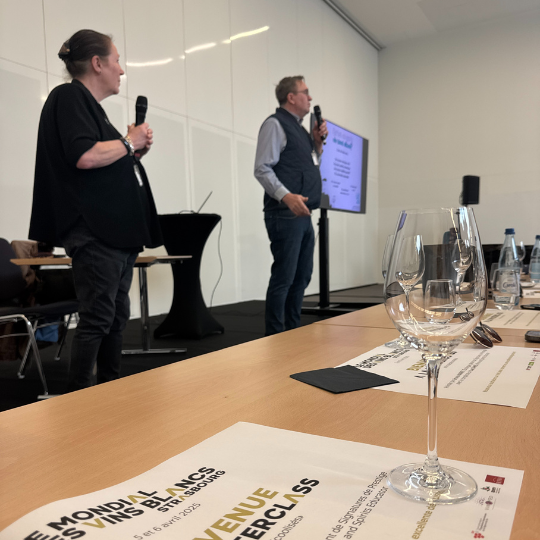
On Saturday 5 April, under the spotlight of the Mondial des Vins Blancs in Strasbourg, a masterclass dedicated to dealcoholised wines captivated the attention of wine professionals and enthusiasts. Moderated by visionary oenologist Bruno Marret and Worlds expert and judge Sue Eames, this session offered a fascinating insight into a rapidly expanding segment that is redefining the traditional boundaries of viticulture. The masterclass not only highlighted innovations in the field of alcohol-free wines, but also served as a platform to discuss the challenges and opportunities that this emerging market presents.
An inspiring opening
Christine Collins, director of the competition, opened the masterclass with communicative energy, greeting emblematic figures of the wine world such as Monika Christmann, Honorary President of the OIV, and Edita Durcova, Vice-President of Vinofed. Christine Collins also paid tribute to the students of the Alexandre Dumas Hotel School and the International Wine Academy in Alsace (AIVA), highlighting their crucial role in the organization of the event.
A visionary of alcohol-free wine
Bruno Marret, oenologist and wine merchant, shared his atypical career in the field of dealcoholized wines. After graduating from the Faculty of Bordeaux in 1991, Bruno Marret founded the Côte de Vincent in 2002, a pioneering company in the production of alcohol-free wines. "When I started, I had to question my entire wine education," he said, referring to the initial challenges and sarcastic criticism from his peers. His interest in dealcoholised wines was born from a personal awareness and an evening of a little too drunk, "I realised that I was talking nonsense under the influence of alcohol, and this pushed me to look for alternatives".
Bruno Marret insists on the importance of rethinking winemaking traditions to embrace this new trend, "Dealcoholized wine is a major issue on a societal, political and economic level, highlighting that the younger generations are the future consumers of this category of beverages. He also pointed out that de-alcoholized wines are not just a fad, but a real alternative for decades to come.
History and techniques of dealcoholization
The masterclass delved into the history and techniques of dealcoholization. Bruno Marret recalled that the first attempts date back to 1908 in Germany, where the initial objective was to recover the alcohol from wines. Since then, techniques have evolved, with methods such as vacuum distillation, reverse osmosis, and the rotating cone column. "The quality of the base wine is essential to obtain a quality dealcoholised product," said Bruno Marret. He criticized industrial practices that add artificial sugars and flavors to compensate for the loss of flavors during dealcoholization, "A good dealcoholized wine must be based on a high quality wine base," he insisted.
Sue Eames brought an international perspective to the discussion, pointing out that de-alcoholised wines are in high demand in the US, South Africa and the UK, "There is a real demand for alcohol-free alternatives, especially during times like Dry January or for pregnant women. Sue Eames notes that these wines allow people to participate in social events without consuming alcohol, which is especially important in some cultures and religious contexts.
A unique sensory experience
The masterclass continued with a tasting of five dealcoholized wines, offering participants a unique sensory experience. The wines presented included two sparkling wines (a white and a rosé), two reds and a rosé, each dealcoholized by different methods. Bruno Marret explained that de-alcoholised wines can offer a similar complexity and depth to traditional wines, provided they are tasted in the right conditions.
"Dealcoholized wine is only of gustatory interest if it is associated with a dish," highlighting the importance of food and wine pairing to fully appreciate these drinks. He also insisted that de-alcoholised wines should be seen as an alternative and not as a direct substitute for alcoholic wines.
A technical and practical vision
Émilie Lejour, oenologist for the house of Wolfberger and judge of the competition, brought a technical perspective to the discussion, "The presentation was more oriented towards the type of consumer and what audience to target for this type of product". She stresses the importance of explaining to professionals that dealcoholised wines are not simply sugary drinks, but products made with care.
She also highlighted the difficulty of pairing wines tasted with dishes, due to their high sugar content, "Creating a food-wine pairing with what we tasted today is frankly complicated", while acknowledging the existence of better quality dealcoholised wines on the market. She mentioned examples such as the Domaine de la Grenaudière (located in the Muscadet appellation), which offers quality dealcoholised wines, showing that interesting alternatives already exist.
A tasting experience
Éric Fargeas, former director of the Confrérie Saint-Etienne, now retired and taster at the Mondial des Vins Blancs, shared his experience of the masterclass. "For me, the term wine is difficult to apply to this kind of drink." Although he acknowledged the quality of the products presented, he stressed that they cannot be tasted with the mindset of a traditional wine taster.
Éric Fargeas also noted that dealcoholised wines often lack substance and character on the palate, making them difficult to pair with meals. "In terms of typicity, these wines cannot claim a Sigille in the terroir category," he added with a touch of humor, alluding to the award that the award-winning wines at the prestigious Confrérie Saint-Etienne competition wear. However, he acknowledges that these products can have their place in specific contexts, such as aperitifs or late nights, where the goal is to offer a light and pleasant drink.
Market challenges and opportunities
Sue Eames highlighted the challenges and opportunities of the de-alcoholized wine market, "These wines represent an interesting alternative for health-conscious consumers or those with dietary restrictions." She also addressed regulatory and cultural aspects, noting that de-alcoholised wines can open up new markets, especially in countries where alcohol consumption is restricted for religious or cultural reasons.
"Dealcoholised wines can become a common eating habit, like Coca-Cola or orange juice," said Bruno Marret, expressing his hope for the future of these drinks. He encouraged wine professionals to embrace this trend and continue to innovate to offer quality products. Bruno Marret also insisted on the importance of continuous innovation in the field, stressing that dealcoholization techniques must evolve to meet consumer expectations.
The bright future of dealcoholized wine
The masterclass highlighted the promising future of dealcoholized wines. Bruno Marret expressed optimism about the integration of these wines into modern eating habits, "We need to rethink traditions to meet the needs and preferences of modern consumers." He also stressed the importance of education and awareness to enable consumers to better understand and appreciate de-alcoholised wines.
The masterclass ended on a note of optimism, with enriching exchanges between participants and experts. The event not only celebrated innovation in winemaking, but also highlighted the importance of rethinking traditions to meet the needs and preferences of modern consumers.
This masterclass was an eloquent testimony to the evolution of the wine world, where tradition and innovation meet to create new taste experiences. De-alcoholized wines, once considered an anomaly, are now fast becoming a component of the wine industry, offering an alternative for wine lovers around the world. As the market continues to grow and evolve, it is clear that de-alcoholized wines have an important role to play in the wine industry.