This historic visit marks the first time an OIV Director General has undertaken such an extensive mission in the region. In each country, Director General Barker followed a busy agenda, meeting with government representatives, laboratories, research institutes, experts, and leading professional organisations involved in wine and grape production.
Accounting for 11% of global wine production, as well as a significant share of table grape, raisin and grape juice production, the OIV’s South American Member States play an important role in the global vine and wine sector. Throughout the tour, John Barker emphasised the OIV’s commitment not only to advancing scientific cooperation but also to fostering multilateral dialogue and exchange on the OIV’s vision. During this trip, the OIV Director General engaged in discussions on the perspectives and challenges faced by these countries, while also working to bring the OIV closer to their needs. In a challenging global context, such cooperation and dialogue are essential to addressing the sector’s current issues.
Barker said “My objectives for this tour were to emphasise the importance of South America as a vine and wine region, to share the OIV’s renewed strategic vision with key stakeholders, and to hear directly from the OIV’s South American members about their priorities and perspectives. It was a highly valuable and enjoyable experience, and I came away with an even greater knowledge and respect for these countries, their commitment to our sector and their engagement with the OIV. I sincerely thank all the national and regional authorities, the experts and the private sector representatives who shared their viewpoints and their enthusiasm for all things vine and wine during the past 3 weeks.”
5 countries in 25 days
Chile
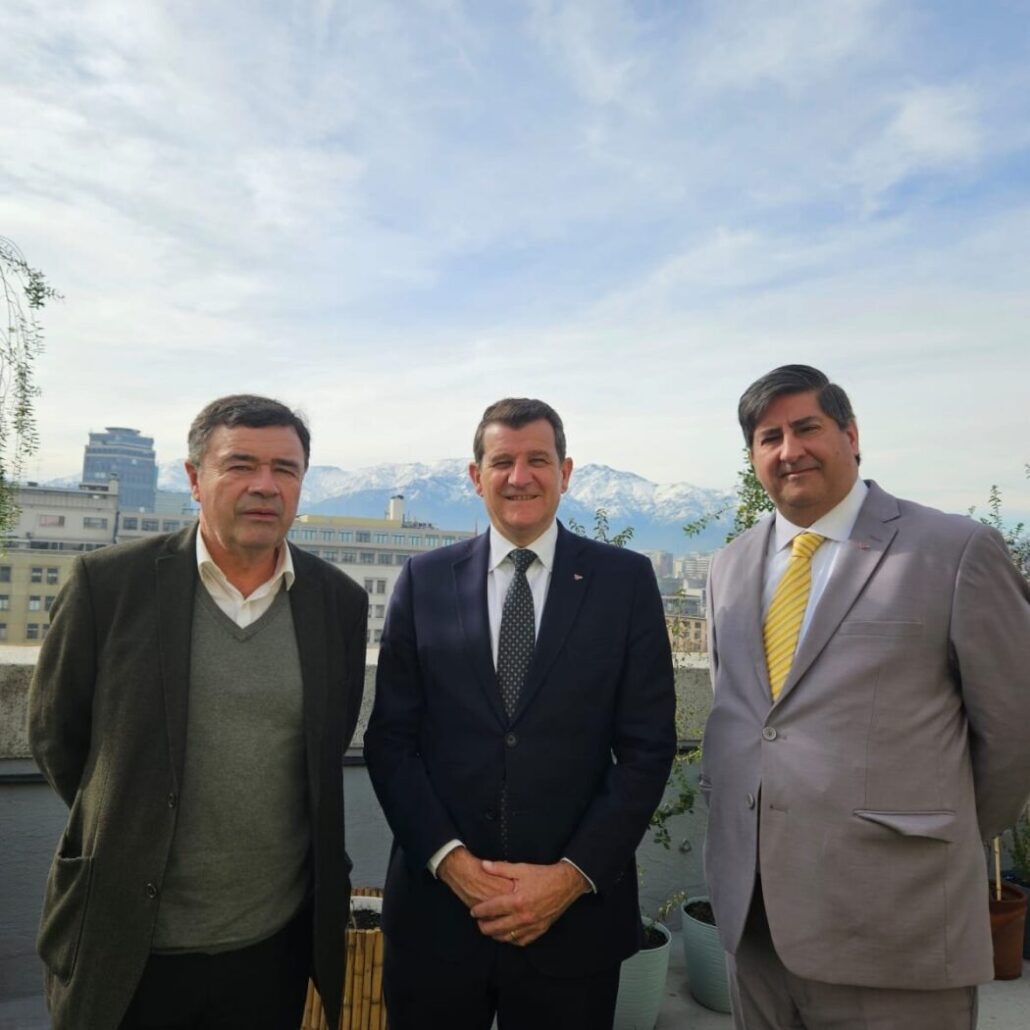
The trip started in Santiago de Chile, where the OIV Director General met with Chile’s Minister of Agriculture, Esteban Valenzuela Van Treek, along with directors and senior officials of ODEPA (Oficina de Estudios y Políticas Agrarias), and SAG (Servicio Agrícola y Ganadero) to discuss the state of the vine and wine sector and Chile’s engagement with the OIV. The Minister reaffirmed Chile’s strong commitment to the works of the OIV. Barker was able to visit the SAG Oenological Chemistry Laboratory to see OIV recommendations being applied in support of product authenticity.
The Director General also had in-depth discussion with representatives from the private sector organisation Vinos de Chile covering subjects such as tariffs and market trends. He visited producers in the Maipo Valley, Elqui Valley and Casablanca, learning about traditional criolla varieties, Pisco Chileno and organic wine production. It was also valuable to meet with representatives of UVANOVA (Comisión de investigación para el desarollo de Uva de Mesa) and FEDEFRUTA (Federación de Productores de Frutas en Chile) representing the table grape sector, to understand more about the market dynamics of this important product.
Peru
In Lima, the OIV Director General was welcomed by Ambassador Eric Anderson Machado, Secretary General of the Ministry of Foreign Affairs. A round-table discussion was held with senior representatives from the Ministry of Production, the Ministry of Agrarian Development and Irrigation and Ministry of Foreign Affairs covering wine, table grape and Pisco production. Key topics included oenotourism, geographical indications, and the use of irrigation to promote production and mitigate climate change. John Barker also had the opportunity for a meeting with private and public sector representatives including the ADEX (Association of Exporters), the SNI (National Society of Industries), the PROVID (Association of Table Grape Producers), and the National Association of Pisco and wine producers from Tacna, Ica, Lima, Arequipa, and Moquegua which particularly highlighted the ambitions and concerns of the Pisco sector in Peru.
Argentina
The third stop of the trip was Mendoza, Argentina’s most renowned wine region. The visit began with a meeting with Alfredo Cornejo, Governor of Mendoza. Barker visited the two key government agencies supporting the vine and wine sector in Argentina – INV and INTA – both of which have contributed significantly to the works of the OIV. At INV (the National Vitiviniculture Institute) with President Carlos Tizio Mayer, the Director General witnessed the state-of-the-art laboratory applying OIV methods of analysis to promote traceability for Argentinean wine.
At INTA (the National Institute of Agricultural Technology), experts presented the development of new grape varieties for both wine and table grapes, as well as the recognition and promotion of the traditional criolla varieties. Barker was the keynote speaker at a conference at Mendoza’s Enoteca on the situation and challenges of the global wine sector, from the perspective of the OIV, to an audience of officials, researchers, and representatives from across the wine sector. At this conference he was fortunate to meet two former OIV Presidents – Claudia Quini and Félix Aguinaga. The following day, the Director General was hosted by COVIAR (Corporation Vitivinícola Argentina) at the organic Bodega Santa Julia. The mission continued in Buenos Aires, where the Director General held productive meetings with the Secretary of Agriculture, Livestock and Fisheries, Sergio Iraeta, and Fernando Brun, Secretary of External Economic Relations at the Ministry of Foreign Affairs, International Commerce and Worship.
Uruguay
In Montevideo, the OIV Director General was invited to participate in open discussion on the state of the Uruguay wine sector held under the auspices of INAVI (the National Vitivinculture Institute). Speakers included the Vice Minister of Agriculture, Matías Carámbula, and INAVI President, Diego Spinoglio, alongside key authorities and experts. A highlight of the event was the presentation of the OIV Merit Award to Ricardo Cabrera, former President of INAVI, by John Barker. The Director General visited the INAVI laboratory and was shown the new digital traceability system linked to a highly detailed vineyard cadastre. His programme continued with a field visit to several vineyards and wineries across the country where key subjects included sustainability, culture and the future orientation of the wine sector. During these visits, Barker attended a working lunch with Vice Minister Carámbula and Mario Lubetkin, Minister of Foreign Affairs at Antigua Bodega Stagnari and saw the development of wine tourism initiatives in the north of the country.
Brazil
Brazil was the final country visited in the Director General’s tour. In Brasília, John Barker was welcomed by senior representatives of the Ministry of Agriculture and Livestock, including Carlos Goulart, Secretary of Agricultural Defense, and Luis Rua, Secretary for Trade and International Relations. He also held a meeting with Ambassador Philip Fox Gough, Secretary of Economic and Financial Affairs of the Ministry of Foreign Affairs. The OIV Director General also visited the recently developed Brasília wine region, where he saw the production of “winter wines” using the innovative double pruning system. The mission then continued in Bento Gonçalves, the biggest wine region of the country. The Director General travelled to Valle dos Vinhedos, Brazil’s first appellation of origin and a major wine tourism destination. He visited the innovative TECNOVIN facility and observed the implementation of new technologies in grape juice production, a sector that has been expanding in Brazil since 2000. After a press conference hosted by representatives from the private sector organisation CONSEVITIS, Barker visited Salton winery, where the national agricultural research institute EMBRAPA made a presentation about new disease-resistant grape varieties. Finally, the Director General visited the Garibaldi cooperative to discuss the importance of the cooperative model in supporting small and medium-sized producers and driving innovation. John Barker was accompanied throughout by representatives of the Department of Inspection of Products of Plant Origin of the Ministry of Agriculture and Livestock, as well as sector representatives, including Brazilian Association of Grape Juice Industry and the Chamber of the Viticulture, Wines and Derivatives Production Chain, who demonstrated the strong commitment of Brazil to the OIV.
South America’s scientific contribution to the OIV
South America is a key region for the world of vine and wine. It is a leader in wine, grape spirits, table grape, dried grape, and grape juice production, with excellent terroirs, heritage grape varieties and a commitment to science and innovation. This region has played an essential role in the works of the OIV for many decades. Between 1986 and 2016, four World Congresses of Vine and Wine were held in the region, underscoring South American countries’ strong commitment to advancing global research in the vine and wine sector. Furthermore, in 2023, Chile hosted the OIV Ampelography Course, the first ever organised in the Southern Hemisphere. South America has also played a significant role in the history of the OIV, with several representatives serving as presidents and honorary presidents. Alejandro Hernández (Chile) served as OIV President from 1994 to 1997, Félix Aguinaga (Argentina) held the position from 2000 to 2003, Claudia Quini (Argentina) from 2012 to 2015 and Regina Vanderlinde (Brazil) from 2018 to 2021 also served as OIV Presidents. Currently, South America has also been represented within the OIV in key positions, such as Fernanda Spinelli (Brazil), who serves as President of the Sub Commission on Methods of Analysis, and Rodrigo Espíndola (Argentina), who chairs the Sub-Commission on Table Grapes, Dried Grapes, and Unfermented Products.
Source: Eca Comercio Agrario
Actualidad del Sector Agroalimentario