At the opening of the Vinitech exhibition in Bordeaux, the challenge is to reconcile the technical solutions that exist to meet climate and societal challenges while preserving the economic and philosophical model of the signs of quality.
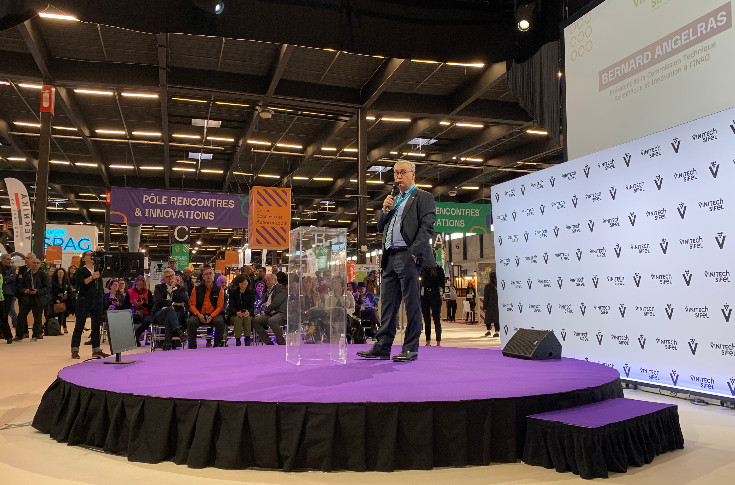
Recalling that the wine sector chooses to "put innovation at the heart of the debate" in the face of climate change, Bernard Angelras stresses that "we could even make it a slogan: we innovate to stay". -
photo credit: Alexandre Abellan (Vitisphere)
his was the key word of this inauguration of the twenty-ninth Vinitech-Sifel exhibition on November 29 in Bordeaux. First a time of reunion, since the last edition 2018 face-to-face (the covid having digitized the event in 2020). But above all, a time of reflection on the difficult balance to be found between the urgency of adapting the vineyard to the multiple current changes and the need to test new practices before adopting and deploying them.
Recalling the current challenges (climate, trade...), Marc Fesneau, the Minister of Agriculture, summarizes in a filmed speech that "innovations will require changes in the regulatory framework relating to appellations of origin and geographical indications, which represent 95% of the volumes produced in France. They should allow greater flexibility of adaptation and the integration of experimental processes within the specifications without affecting the fundamentals of what makes the strength of the appellations, namely the link to the terroir and the differentiating character of the products and their typicity. "Let be a new form of "at the same time".
"French viticulture is at a crossroads. So much we have to do in terms of innovation, societal expectations and the economy. Climate change can federate all three," confirms Bernard Angelras, president of the scientific technical and innovation commission of the National Institute of Origin and Quality (INAO). Pointing to the INAO's questioning of Varieties of Interest for Adaptation Purposes (Vifa), the Costières de Nîmes winemaker sees it as a model of experimentation to "allow to supervise and accelerate experimentation within our appellations, in accordance with the definition of appellations of origin". For Bernard Angelras, "this VIFA experimental model can be deployed for other issues because it is not dogmatic and it is probative", knowing that "there are no obvious, definitive and universal solutions", but that "it is necessary to evaluate them".
A trial time sometimes to negotiate. As with the Young Farmers' call for a moratorium on agrivoltaism. "Going fast is the antithesis of doing well," says Julien Rouger, a member of the Young Farmers board. For the winegrower in Charente-Maritime, the interest in photovoltaic shades must be validated by tests, but the artificialization of photovoltaic panels on agricultural land must be banned: "everything in its time, you have to know what we are talking about. Take into account local issues". President of the association France Agrivoltaïsme, Antoine Nogier defends a ridge line: "we must go fast and well", knowing that "the decisions taken today will have an impact for 2050. Where we will see 2022 as a cool climate, while it is one of the hottest vintages. »
Source;Vitisphere