For Bernard Angelras things are clear: faced with issues related to climate change, it is necessary to observe, research, innovate, and but also to support winegrowers, explains the president of the IFV.
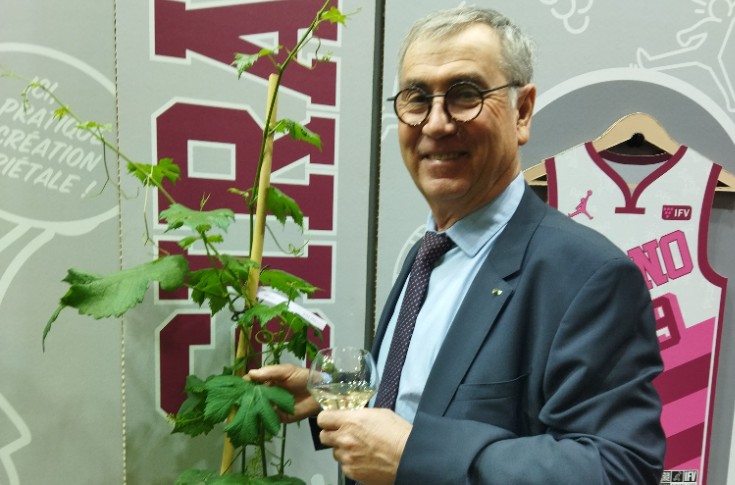
"If there are moments that mark in a profession, today we live one!" - photo credit: IFV
Three things are important to respond to the consequences of global warming: understanding climate issues but also societal expectations, imagining solutions to the problems, convincing as many actors as possible." says Bernard Angelras, president of the French Institute of Vine and Wine (IFV), re-elected at the International Agricultural Show on March 1, 2023.
For the Gard winemaker, who is also president of the Costières de Nîmes appellation union, innovation is the key word to initiate and develop the agroecological transition in French vineyards. Plant innovation would not only make it possible to respond to the problems of frost, ever longer periods of drought, the reduction and better use of phytosanitary products, but also to that of difficult vinification because of the difference in maturity between the juice and the skins. For Bernard Angelras, also president of the Scientific, Technical and Innovations working group of the National Committee of Wine AOCs (CNAOV), it is necessary to "innovate to stay" (in accordance with the strategic plan of the sector).
Indeed, varietal evolutions will have to continue to respect the typicality of wines to allow appellations to adapt, but will not prevent us from reinventing the wines of tomorrow.
Without accompaniment there will be no changes
To do this, the president of the IFV, considers that it is necessary to focus on the level of the 8 regional poles that compose it to rethink new models in consultation with the interprofessions, the defense and management organizations (ODG) but also with the winegrowers, the main actors.
From the bottom up, it is now essential to take into account the evolution of climate, societal and professional changes in order to be able to tackle the practice of agroecology in our vineyards.