Abstract
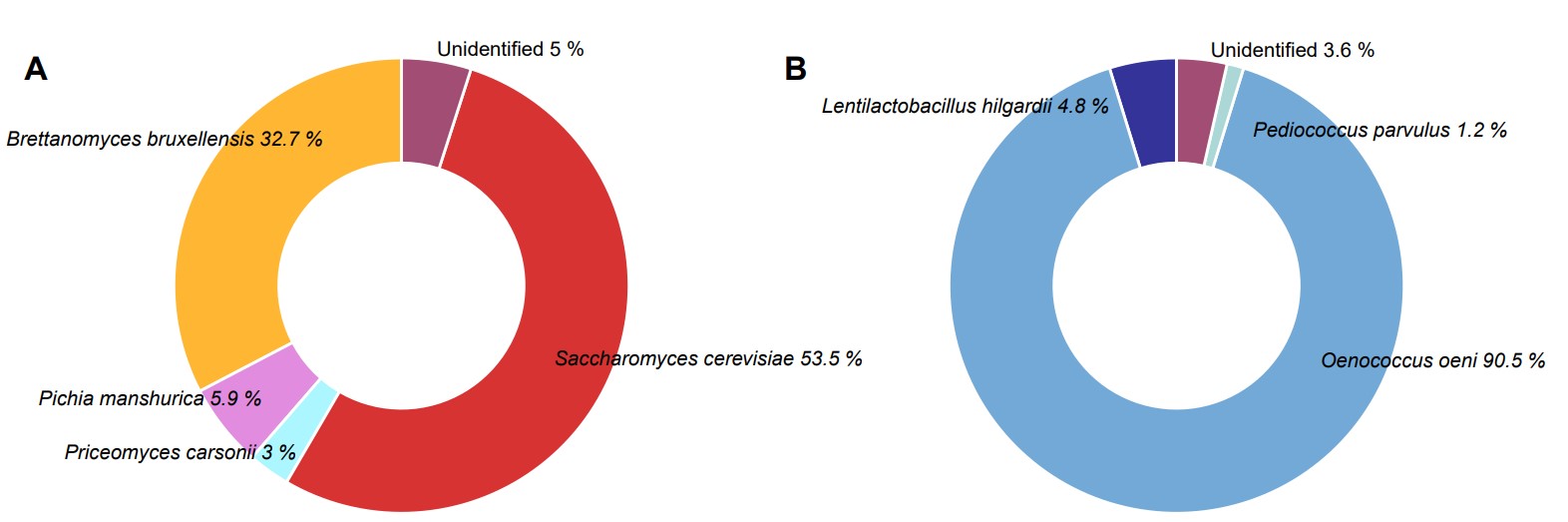
In recent years, the frequency of occurrence of mousy off-flavours in wines has increased. This could be caused by the significant decrease in sulphur dioxide addition during processing, the increase in pH or even the trend for spontaneous fermentation in wine. This off-flavour was associated with Brettanomyces bruxellensis or lactic acid bacteria metabolisms. Three N-heterocyclic compounds (APY, ETHP, ATHP) were described as involved in mousiness perception. Thus far, no study addressed the variability in that N-heterocycles production according to microorganism strains from different species. Twenty-five wines presenting mousy off-flavour were analysed. In total, 252 bacteria with 90.5 % of Oenococcus oeni and 101 yeast strains with 53.5 % of Saccharomyces cerevisiae were isolated and identified. Their capacity to produce mousy compounds was investigated using Stir Bar Sorptive Extraction-Gas Chromatography-Mass Spectrometry (SBSE-GC-MS) and a standardised N-heterocycle assay medium. While four and three species of yeast and bacteria, respectively, were isolated from mousy wines, only three species of microorganisms were associated with N-heterocycles production: B. bruxellensis, Lentilactobacillus hilgardii and Oenococcus oeni. The screening was then extended to collection strains for these three species to improve their genetic representativity. Our results show that the levels and the ratios of the three N-heterocycles present huge variations according to the species. In addition, it has been shown that in most mousy wines, B. bruxellensis was not found. Finally, an interesting correlation between ATHP and ETHP was identified.
Introduction
Taints and off-flavours are one of the major concerns in the wine industry and even if the issues provoked by them are harmless, they can still have a negative impact on the quality or the visual perception of the consumer (Ridgway et al., 2010). The mousy taint was first reported in cider. It was described as a “Peculiarly disagreeable flavour in wine, which is closely resembling the smell of a residence of mice” (Thudichum, 1894). In the past, it was relatively easy to control it by protecting the wine from microbial spoilage with sulphur dioxide (SO2) and high acidity (Bartowsky, 2009).
Nowadays, it is more common to detect wines with mousy off-flavours (Tempère et al., 2019). Massini and Vuchot (2015) outlined that the significant decrease in sulphur dioxide, the increase in pH and the trend for spontaneous fermentations in wines could be the reasons behind this. Recently, Pelonnier-Magimel et al. (2020) studied the quality of 52 wines vinified without adding SO2 and 20 wines with a classical addition of SO2: 70.6 % of the wines without SO2 were described with an off-flavour and 6.2 % of the wines presented a mousy taint.
1. Mousy off-flavour
Mousiness is a consistent underlying problem for the wine industry (Fugelsang and Edwards, 2007; Grbin et al., 1996). There are three identified N-heterocyclic compounds associated with mousiness, 2-ethyltetrahydropyridine (ETHP), 2-acetyltetrahydropyridine (ATHP) and 2-acetylpyrroline (APY) (Costello et al., 2001; Herderich et al., 1995). One particularity that makes this wine taint very unique is that it is difficult to smell it by ortho-nasal perception. The mousy compounds are not sufficiently volatile to be detectable at wine pH (Bartowsky and Henschke, 1995). However, when the wine comes into contact with saliva, the neutral pH of the mouth (Larsen et al., 1999) permits the deprotonation of N-heterocycles and increases their volatility. The acid–base equilibrium allows the perception by retro-olfaction. Another specificity is the persistence of mousy compounds in the mouth at more than 10 minutes after swallowing or spitting the wine (Grbin et al., 1996).
Production of mousy N-heterocycles in wines is attributed to Brettanomyces yeasts and lactic acid bacteria (LAB). However, no extensive investigation has been done to search for other species likely to produce mousy off-flavours in wines and, on the other hand, microbial mechanisms leading to the development of this alteration are still unclear. It has been suggested that the presence of amino acids such as L-lysine and L-ornithine could be fundamental for the ring formation of ATHP and APY, respectively. Ethanol could also be essential for the formation of mousy compounds considering the acetyl chain of APY and ATHP. Other compounds such as ethanal, metal ions and oxygen may also play an important role in the production of mousy N-heterocycles (Costello and Henschke, 2002).
2. Brettanomyces bruxellensis
B. bruxellensis is the main species from the genus Brettanomyces described in wine. This yeast has a good resistance to the low pH and strains show some differences of sensitivity against the SO2 antimicrobial activity. Nunes de Lima et al. (2021) noticed some differences in tolerance regarding the grape variety. It may be explained by the phenolic composition of wines. B. bruxellensis is really well known for its negative contribution to wine odour (Chatonnet et al., 1992; Harrouard et al., 2022). B. bruxellensis can produce volatile phenols, such as 4-ethylphenol and 4-ethylguaicol from cinnamic acid derivatives (Romano et al., 2008). These compounds are undesirable and associated with the “Brett character” in wine, recognised as an off-flavour (Tempère et al., 2014). They have a characteristic odour, variously described as stable, horse sweat, leather and phenolic, as well as pharmaceutical (Tempère et al., 2019).
B. bruxellensis have also been associated with other spoilage. They can produce a high amount of acetic acid (Peynaud and Domercq, 1956; Schanderl, 1951). They can also induce turbidity in wine (Van Der Walt and Van Kerken, 1958; Van Der Walt and Van Kerken, 1959; Van Zyl, 1962) and are sometimes associated with spoilage of other beverages such as soft drinks (Kolfschoten and Yarrow, 1970), beer (Rainbow, 1981; Smith et al., 1981) and cider (Beech, 1958; Cabranes et al., 1990; Tucknott, 1977).
Several strains of B. anomalus and B. bruxellensis, known to be associated with the spoilage of wine or other fermented beverages, have been shown to produce a mousy taint when fermenting grape juice or by contamination on finished wine (Grbin and Henschke, 2000; Heresztyn, 1986; Romano et al., 2008). Their ability to produce ATHP and ETHP has been confirmed using different chemically defined media containing among others ethanol and lysine (Grbin, 1998).
3. Lactic acid bacteria
The LAB are crucial in the vinification process of wines: some strains of Oenococcus oeni promote most of the time the progress of the malolactic fermentation (MLF) in red wines and part of white wines. They belong to the must and wine indigenous microbiota and develop spontaneously during or after alcoholic fermentation (Lonvaud-Funel, 1999; Lonvaud-Funel et al., 1991). Most of the time, the MLF proceeds satisfactorily but harsh conditions (low temperatures, low pH, etc.), or a low population of native bacteria can cause late onsets of MLF or languid fermentations.
To facilitate the triggering of MLF it is possible to use malolactic starters (Kunkee et al., 1964). These are selected for their technological properties and their adaptation to the environment, therefore, tolerating difficult physicochemical conditions, such as acidic pH, relatively low temperatures and the presence of ethanol (Torriani et al., 2011). At that time, the ability to produce the mousy off-flavour is not verified before commercialisation.
LAB are also known as mousy off-flavour producers. L. hilgardii and Levilactobacillus brevis known to be responsible for the “amertume” in wine (Ribéreau-Gayon et al., 2006), were the first LAB species linked to mousy off-flavour (Heresztyn, 1986; Tucknott, 1977). These bacteria have been shown to produce large amounts of ATHP and smaller quantities of APY and ETHP when incubated in a synthetic medium (Costello and Henschke, 2002). O. oeni, the preferred bacterium for MLF, has been highlighted to produce APY, ATHP and ETHP (Costello, 1998; Costello et al., 2001). Several O. oeni strains have also been found to be capable of producing strong mousy off-flavour during growth in an ethanolic grape juice medium (Romano et al., 2008). Indeed, preliminary unpublished results showed that 13 strains of O. oeni out of 14 tested produced APY in a model medium under standardised conditions at concentrations above the threshold of detection.
The objective of the present work was to describe the variability of the production of mousy N-heterocycles by wine microorganisms considering their genetic diversity. Bacteria and yeasts isolated from a large collection of mousy wines were identified and screened for their capacity to produce mousy compounds under standard conditions. The screening was extended to collection strains belonging to species known as producers of mousy N-heterocycles.
Read more:
https://drive.google.com/file/d/1OIIe6SYjb12Nq5G-rZAfkKkks5VQ9Ylz/view?usp=sharing
Source: IVES https://doi.org/10.20870/oeno-one.2023.57.2.7481