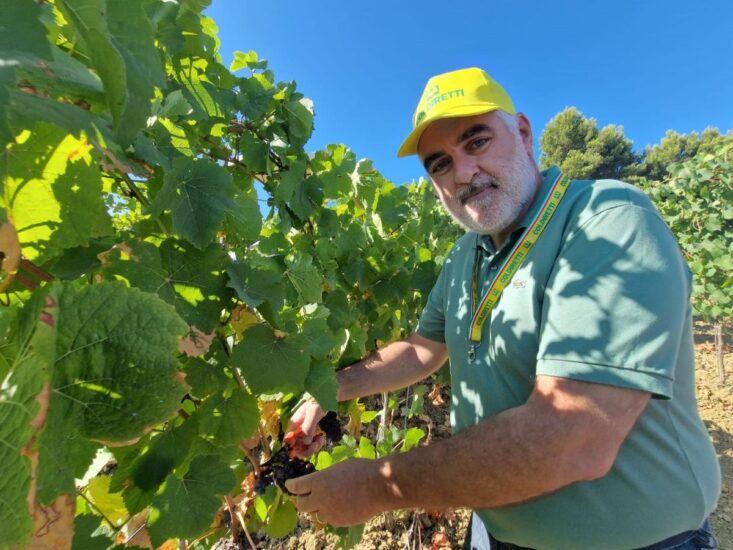
In a complex season from a weather point of view, the 2023 harvest in Italy has begun, as told by WineNews, but paying a heavy duty for the effects of climate change that, between bad weather and heat waves, have damaged the vineyards with the national production estimated, according to Coldiretti, down by 14%, but with collapses of up to 50% in the Central South marking, For those areas, the worst result of the century.
Italian production should fall to around 43 million hectoliters against the 50 million recorded last season, making 2023 one of the worst years in the history of the Italian vineyard in the last century together with 1948, 2007 and 2017. In Italy, however, quality production is expected, but, for volumes, much depends on the evolution of temperatures and precipitation in the coming weeks and the impact of climate change, with winemakers who must be increasingly careful to choose the right time for harvesting and processing in the cellar.
According to the first projections, in the absence of further adverse events, for the conquest of the first place as a world wine producer is expected, highlights Coldiretti, a head to head between Italy and France, which is dealing with diseases of the vine and bad weather, while Spain, where the weather has anticipated the harvest by at least two weeks, It should remain third with 36.5 million hectoliters and a decrease of 11% on 2022.
In Italy, despite the investments made by farmers to protect the health of the vineyards, with an increase in production costs that weighs on the budgets of the companies, there are important regions such as Sicily and Puglia, which represent over 1/5 of all the wine of the Belpaese, with losses between the rows up to 40%, while in some areas between Molise and Abruzzo there is a collapse of up to 60% of the bunches to be harvested. The situation is also difficult in Tuscany, but it improves moving northwards, where yields are stable or grow slightly over 2022. And if in Romagna the flood has given a hard blow to the vineyards, in Emilia, despite the hailstorms, production resists following the entire ridge that from Modena, Piacenza and Parma goes up to the Oltrepò Pavese and Astigiano. From Piedmont to Veneto, passing through Lombardy, yields are stable despite the storms and hailstorms that have hit like a leopard in recent weeks, in a North that this year should produce 65% of all national wine.
A scenario that sees the harvest in Italy traditionally starting with the grapes from sparkling wines Pinot and Chardonnay in a path that continues in September and October with the Glera for Prosecco and with the great native red grapes Sangiovese, Montepulciano, Nebbiolo and ends even in November with the grapes of Aglianico and Nerello on 658,000 hectares cultivated nationally.
The tricolor production, underlines Coldiretti, can count on 635 varieties registered in the vine register, twice as many as the French, with bottles made in Italy destined for 70% to Docg, Doc and Igt with 332 wines with controlled designation of origin (DOC), 76 wines with controlled and guaranteed designation of origin (DOCG), and 118 wines with typical geographical indication (IGT) riconosciuti in Italy and the remaining 30% for table wines demonstrating the rich heritage of biodiversity on which Italy can count that boasts throughout the Peninsula the possibility of offering local wines of the highest quality thanks to a millenary tradition. "With the harvest in Italy, a system is activated that offers job opportunities to 1.3 million people directly engaged in vineyards, cellars and commercial distribution, both for those employed in related activities and service", explains Coldiretti president, Ettore Prandini.
A heritage of culture, history, economy and work put at risk for Coldiretti by the entry into force of the Law on alarmist wine labels after the European Commission gave the green light for silence-assent to the Irish proposal It is in fact a trade distortion rule that is the result of an ideological approach towards a food like wine that is fully part of the Mediterranean diet and counts ten thousand years of history and whose traces in the world have been identified in the Caucasus, while in Italy there are findings in Sicily already 4,100 years before Christ. "It is completely improper to assimilate the excessive consumption of spirits typical of the Nordic countries to the moderate and conscious consumption of quality products with a lower alcohol content such as beer and wine that in Italy has become the emblem of a slow lifestyle, attentive to the psycho-physical balance that helps to feel good about oneself, to be contrasted with the unregulated intake of alcohol", continues Prandini in underlining that "the right commitment of the Union to protect the health of citizens according to Coldiretti cannot translate into simplistic decisions that risk unjustly criminalizing individual products regardless of the quantities consumed".
Focus - After the jump in electricity and gas costs, now soaring the cost of glass for bottles: +54%
The surge in the cost of hollow glass for bottles, as we have been reporting for months now on WineNews collecting the voices of the sector, supply chain organizations, producers and denominations on all the "raw materials" related to the production of wine, With an increase that has reached + 54% in the last two years, it adds to the heavy national logistics gap and slows down the export of wine made in Italy in the world. This is confirmed by a Coldiretti analysis on data from Centro Studi Divulga at the start of the harvest in Italy.
While the jump in costs in 2022 was justified by price spikes for electricity (€543 per megawatt-hour) and gas (€233 per megawatt-hour), the subsequent fall in energy prices did not have a positive effect on glass prices. In fact, according to Divulga data, in the last 12 months, gas and electricity prices have collapsed by 85% and 79% respectively, while in the same period the glass cost index has continued to grow with a + 24% in the last year.
This scenario is also weighed down by the increase in fuel prices and a heavy Italian logistics deficit due to the lack of infrastructure for freight transport, which costs our country over 13 billion euros, with a gap that penalizes the national economic system compared to other European Union countries. This is a burden for Italian economic operators 11% higher than the European average and hinders the development of the country's economic potential, in particular for wine, which is the most exported Italian agri-food product abroad with a value that in 2022 is equal to 7.9 billion on world markets. In the face of rising costs, foreign sales are holding back this year with an increase of just 2% in the first four months of 2023 also due to the slowdown in the economy and inflation that has cut the spending power of consumers globally. To support exports is Prosecco which marks a more than double progress (+5%) on the national trend and which represents the most appreciated Italian wine with over 1/5 (20.3%) of sales abroad.
On the European continent, Italian wine finds its largest consumer in Germany with + 2.7% of sales also in the first four months of 2023, but it is also growing at home of our first competitors given that France records a strong increase in purchases of Italian bottles (+ 24%), while in the United Kingdom, between economic slowdown and inflation, the consumption of Italian bottles recorded a negative figure of -2.2%. Instead, despite the tensions related to the war between Russia and Ukraine, in Putin's country sales of Italian bottles grew by +67% in the first quarter of the year. Outside Europe, the main market is represented by the United States where, despite everything, purchases recorded an increase of + 4% between January and April 2023.
An international appreciation that has also caused the spread of products that exploit the Italian sounding that cause losses estimated at over a billion euros on world markets without counting the risks related to the requests for recognition of Denominations that evoke the etc.ellenze made in Italy as in the case of Croatian Prosek. However, the market for fakes remains a very flourishing market where the risks concern the use of the same or similar names or similar to indicate very different products. From the Argentine Bordolino in the white and red version complete with a tricolor flag to the German Kressecco, but there are also the white Barbera produced in Romania and the Chianti made in California, the South American Marsala and the American one among the counterfeits and imitations of our most prestigious wines and liqueurs.
"To defend the Italian wine heritage it is necessary to intervene to contain production costs with immediate and structural interventions to plan the future", underlined the president of Coldiretti, Ettore Prandini, explaining that "protecting wine means protecting the main driving force for the entire agri-food system not only abroad but also on the domestic market, starting from the tourism sector". "In this perspective, the National Recovery and Resilience Plan (PNRR) can be decisive in supporting the competitiveness of companies by unlocking infrastructures that would improve connections between the South and North of the country and also with the rest of the world by sea and rail, with a network of hubs composed of airports, trains and cargo".
Source: Winenews.it