Vitisphere By Marion Bazireau
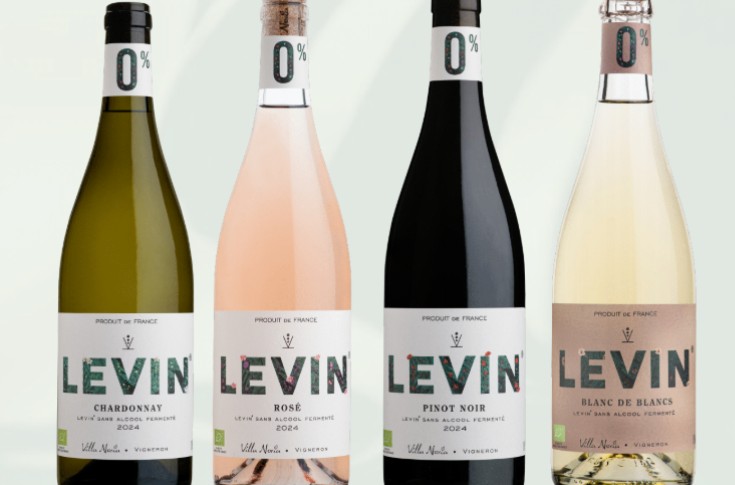
An oenologist is debating a new range of Chardonnay, Syrah and Pinot juices fermented by a sourdough made of bacteria and non-Saccharomyces yeasts that does not produce alcohol. His "natural" drinks are, according to him, much more virtuous for the environment than dealcoholized products.
How can we dare (and how can frauds let it happen) sell a product that is not wine by writing in huge "LEVIN" on the label? Matthieu Lequeux, consulting oenologist, is annoyed. "How can you advertise a fermented chardonnay without alcohol? The very principle of fermentation is to transform sugar into alcohol, I believe that you must be clear and not deceive the consumer! adds winemaker Bertrand Gourdou. The launch of the "Levin" range in wine shops and organic stores by the Villa Noria estate, in Montagnac, in the Hérault, is unleashing passions on social networks. "We properly inform consumers by indicating on the packaging of our Chardonnay, Pinot Noir, and Syrah rosé that they are organic fermented grapes without alcohol," retorts inventor Fabien Gross, who spent ten years at the Grands Chais de France and created the Pierre Chavin brand, which he sold entirely to his former partner in 2021.
Saying he is always disappointed with the quality of de-alcoholised wines or grape juices diluted in infusions, the Alsatian has taken advantage of his non-competition period to work on "a real innovation", a fermentation that does not produce alcohol. "I asked a laboratory to prepare a sourdough made of non-Saccharomyces yeasts and a mix of lactic acid bacteria used in other agri-food sectors," he reveals, without detailing the patented list of strains that took him 3 years to select.
Only grapes
This sourdough transforms the sugar in the berries into lactic acid and CO2. "It produces discreet buttery, floral and lemony aromas that we are used to finding in ageing wines," describes Fabien Gross. The oenologist harvests some of the grapes produced on the 80 hectares of Villa Noria in slightly under-ripe and freezes them. He ferments them on demand in a workshop annexed to the cellar to avoid any contamination by Saccharomyces cerevisiae. "I failed a lot of trials and I invested almost 2 million euros in equipment, especially for pasteurization, but in the end I managed to market a drink containing only 4.8 grams of sugar per 100 ml, made without any inputs, without added flavors, without sulphites, without metabisulfite or potassium sorbate, without citric acid, without anything!" . Fabien Gross packs his fermented grapes without alcohol in reusable bottles. According to his calculations, the carbon footprint of the Levin range is 70% lower than that of a dealcoholised wine.
Returning to the choice of brand, the entrepreneur admits to being "on a knife's edge", with his pun on sourdough. "But if jealous people really come to bother me, they will also hurt 'Chavin', 'Divin', and 50% of alcohol-free brands. Millions of bottles will leave the market, he warns, because today no one is 100% compliant with the regulations, not even the big groups. »
Regretting the controversies of oenologists "museum guards, watching the vines being uprooted without trying anything", Fabien Gross is proud to open up new ways of diversifying viticulture and advises organic winegrowers not to embark on dealcoholization when it is open to them. "They are going to shoot themselves in the foot with very industrial processes, whereas alcohol-free fermentation allows them to innovate in a much more virtuous way for the environment." For the past two years, Fabien Gross has also been marketing Sobaie kombucha made from grapes.